


Market Update: Deliberately unhelpful?
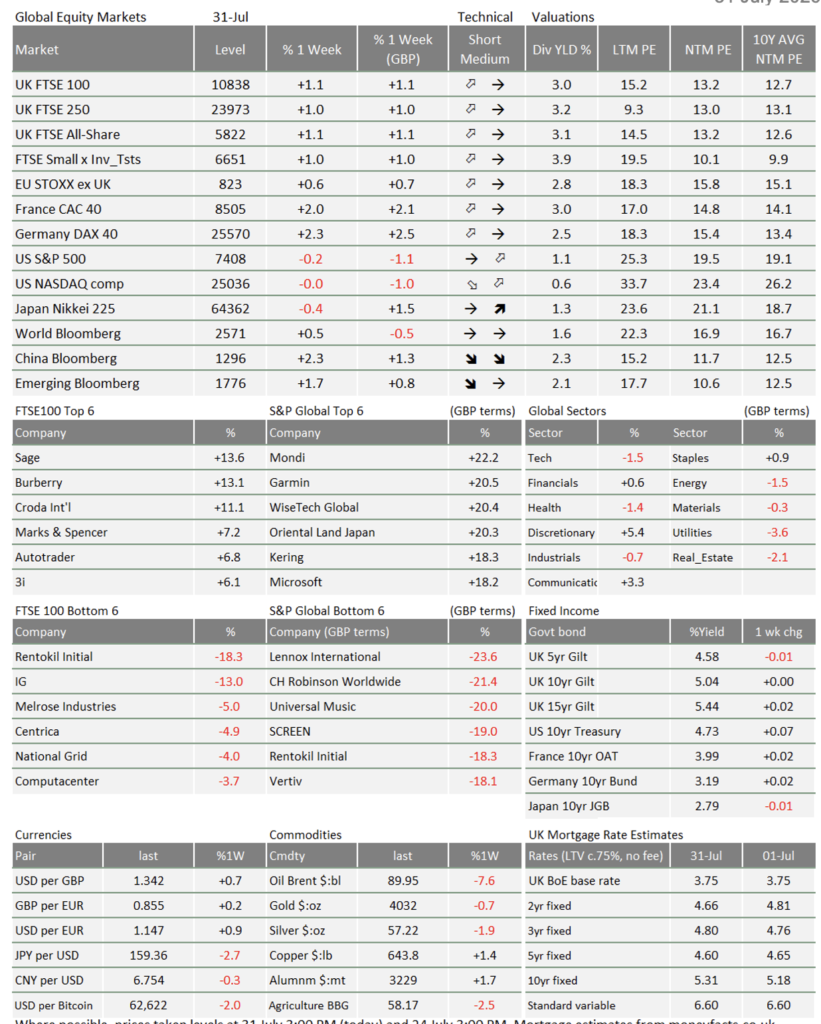
Last week saw marked volatility in bonds and a number of major high-profile stocks. Some of it has been a little concerning and yet, most portfolios will probably show a reasonably positive outcome. That’s what diversification is all about.
The major global themes continue to be AI, the Middle East conflict and now, after a period in the background, interest rates and yields.
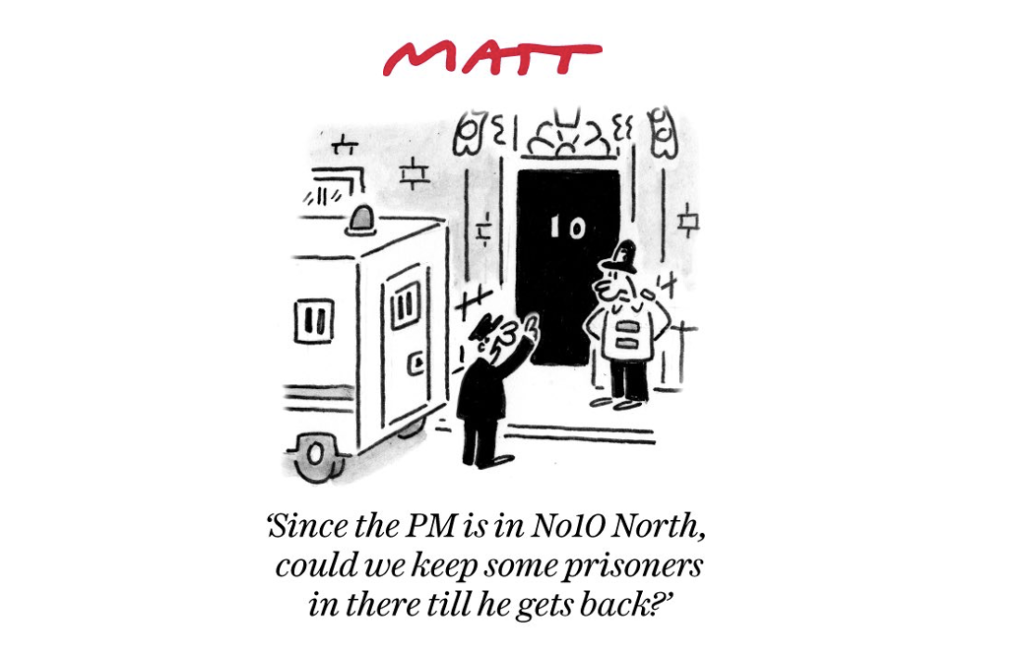
In the UK, the rolling policy pronouncements received a mixed reception among financial commentators. However, both the FTSE 100 and smaller-cap 250 equity indices remain in a strong uptrend. They made new all-time highs while UK government bond (Gilt) yields ended lastweek a little lower. Burnham seems to have regained fiscal credibility although Capital Economics reckons that balancing the spending promises will precipitate another £65bn tax rise – equivalent to Reeves’ first budget move.
The US is about a month into the quarterly earnings season. On July 1st, the index’s earnings per share (EPS) was expected to rise 22.3% (versus Q2 2025). A month in, the index’s Q2 2026 EPS is now expected to record a 27% gain.
Six of the Magnificent Seven have reported, four last week after two the week before. Nvidia comes in the last weeks of the season. Aside from Tesla, these companies form the core of the hyperscaler AI theme, as a main driver of investment in the technology. The AI model producers and chip makers are the biggest beneficiaries but depend on the strength of the hyperscaler investment.
Signals have been mixed on how the investments are performing, how much more investment is to come, who will have the cheapest funding, and therefore, who might come out on top. Which is why we’re seeing significant dispersion in share price performance for what was previously deemed to be quite a homogenous group.
However, as Bloomberg Intelligence points out, the recent underperformers, such as Meta, still have vast resources of profit in the underlying businesses. This keeps their credit ratings so much better than the vast majority of other companies which have an average rating of BBB, just above the investment grade threshold.
Here are their current long-term ratings from Moody’s and Standard & Poor’s:
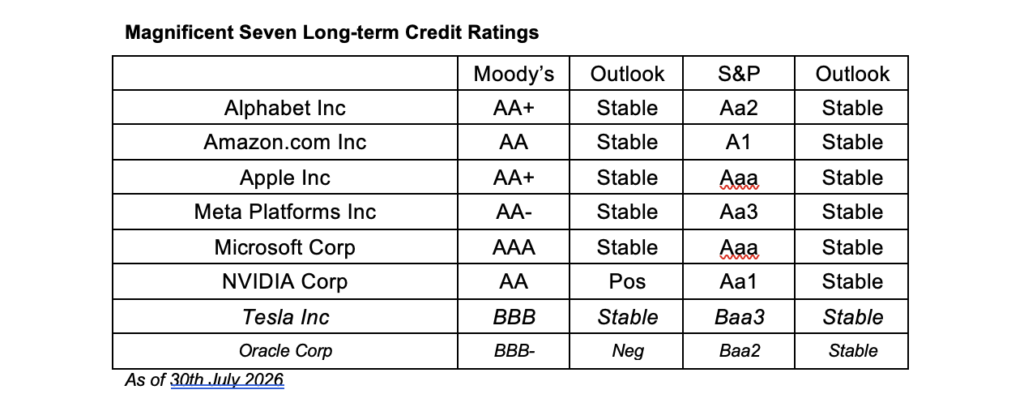
The main six companies have a vast amount of capacity to sweat their credit availability and leverage up before they get close to being downgraded. Perhaps, the question was always why they did not pay even more money back to shareholders. The advent of Artificial Intelligence has given them the opportunity, which makes investment and leverage worthwhile.
Thus, recent worries about the likely pace and ultimate size of hyperscaler investment were always likely to be short-term, even if the likes of Oracle are being shut out of the game. Chip stocks, the main investment beneficiaries, had a wild ride last week. South Korea’s SK Hynix was down on Wednesday from the previous week’s close by over 25%. It’s now up over 35% from Wednesday’s low (as at Friday, meaning the share price is unchanged mathematically!).
The list of countries now involved in the Middle-Eastern conflict is lengthening. Houthi attacks were always likely to involve Saudi Arabia, but now US missiles have hit Iraqi territory and Ukraine has begun to hit Iran’s ships in the Caspian Sea. This suggests a widening of scope and capacity which has the potential to continue a conflict rather than resolve it in the short-term.
The growing power of the anti-Iran allies also raises the probability of a better outcome for them. However, oil and energy prices still remain high and unlikely to fall any time soon. Meanwhile, diesel reserves are getting very tight and prices are back at the highs seen in March. Markets have become even less sensitive to the news flow so maybe we shouldn’t worry.
The July round of global monetary policy meetings concluded today with no change in rates among the major central banks. The Bank of England kept rates unchanged, and Andrew Bailey maintained a dovish tone in the press conference, despite three votes out of the nine seeking a rise.
The biggest market impact came after Wednesday’s Federal Open Market Committee meeting in the US. Although there was no change, three voters sought a hike, and they made no reference to changing inflation conditions such as energy prices.
Warsh, in his second press conference outing, was less helpful than in his first. Well-mannered and unflustered, he declined to shed light on the decision-making process. Rather, he told us that we should make up our own minds where we think rates and other policy dynamics will go, and not pressure the FOMC members to commit to any possible course of action before they meet.
Longer bond yields went up sharply while the US dollar weakened during the press conference, which many thought showed investors were deciding that rates are likely to go up. A better explanation of the yield rise would be that Warsh’s dislike of giving guidance or explaining his thoughts raises the risks (especially for foreign investors) of holding longer-dated, more price-volatile bonds.
From our perspective, Warsh could be a little more helpful in explaining why it’s a good idea to be unhelpful. Generally, the evidence available to the members of the FOMC is no better than is available to professional investors, who also have excellent analysts. Despite this informational equality, the financial media spends much time and effort on gauging the “views” of the FOMC members and essentially requiring them to decide before the decision. We don’t know if this will cause inflexibility, but there is a risk it might happen, and potentially at the points when most flexibility is needed (such as during the pandemic-led inflation surge).
The Jackson Hole meeting on 27-29th August will be an opportunity for him to set out why we shouldn’t be so upset about a little less jawboning. In the meantime, investors and financial commentators will get used to the new normal quite quickly, while realising that what matters is our general belief that the Fed is committed to the 2% inflation target rather than any particular policy move.
This week’s writers from Tatton Investment Management:
Lothar Mentel
Chief Investment Officer
Jim Kean
Chief Economist
Astrid Schilo
Chief Investment Strategist
Isaac Kean
Investment Writer
Important Information:
This material has been written by Tatton and is for information purposes only and must not be considered as financial advice. We always recommend that you seek financial advice before making any financial decisions. The value of your investments can go down as well as up and you may get back less than you originally invested.
Reproduced from the Tatton Weekly with the kind permission of our investment partners Tatton Investment Management
Who are Vizion Wealth?
 Our approach to financial planning is simple, our clients are our number one priority and we ensure all our advice, strategies and services are tailored to the specific individual to best meet their longer term financial goals and aspirations. We understand that everyone is unique. We understand that wealth means different things to different people and each client will require a different strategy to build wealth, use and enjoy it during their lifetimes and to protect it for family and loved ones in the future.
All of us at Vizion Wealth are committed to our client’s financial success and would like to have an opportunity to review your individual wealth goals. To find out more, get in touch with us – we very much look forward to hearing from you.
The information contained in this article is intended solely for information purposes only and does not constitute advice. While every attempt has been made to ensure that the information contained on this article has been obtained from reliable sources, Vizion Wealth is not responsible for any errors or omissions. In no event will Vizion Wealth be liable to the reader or anyone else for any decision made or action taken in reliance on the information provided in this article.
