


Market Update: Bumpy ride towards a better place
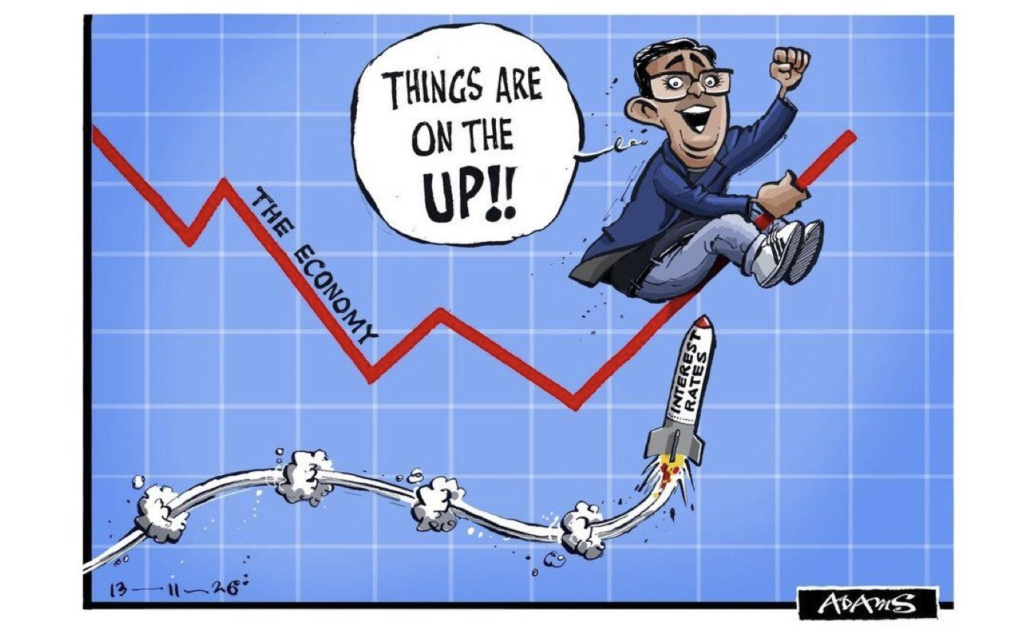
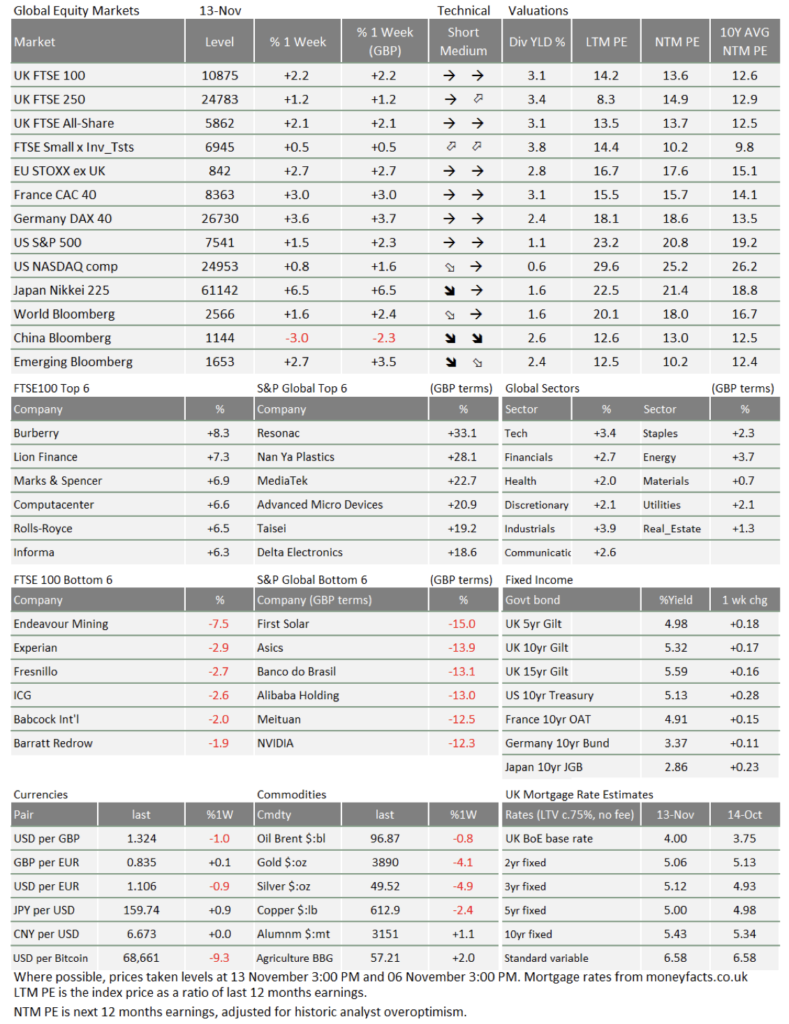
Global stocks staged a decent recovery last week. That might sound surprising given the leadership turmoil engulfing the world’s second most valuable company (at the time of writing) Nvidia. We write about the impact of Jensen Huang’s downfall on the AI chipmaker in a separate article, but the important thing to note is that Nvidia’s tumbling share price has had a relatively minor impact on overall investment portfolios.
That is largely thanks to a stronger week for other big tech shares. Nvidia’s pain may be a gain for its competitors but much of the positivity came from improved expectations for economic growth and company earnings. Tighter financial conditions – partly because of that growth – complicate the picture, but this looks like a decent background for equities.
Business investment stokes UK growth and (hopefully) exports
With headlines focussed on Nvidia, it largely escaped the attention that the UK economy grew 0.7% in the three months up to September – the fastest quarterly expansion since 2024. JP Morgan’s most recent data paint an equally bright picture for Britain: its nowcasts (an estimate of how strong the economy is right now) imply an annualised growth rate of around 3%. Yet again, UK growth is much better than the dour media narrative suggests.
Stronger growth will unfortunately mean higher inflation and, therefore, interest rates. But high rates are manageable as long as there is growth to back them up.
The UK’s surprisingly strong growth was powered by business investment, particularly AI-related investment. This is unusual for the UK. Historically, our growth has almost always been centred on consumer spending – usually related to the housing market. But right now, Britain’s housing market is struggling, and it is the rest of the private sector doing the business.
That is a very good sign. The problem with the UK’s usual consumption-led growth model is that it tends to widen the current account deficit (exports minus imports), creating long-term structural problems. But now, with a wave of AI-related investment, we might finally see the opposite: growth powered by service exports, especially to Europe. That has not led to any shrinking of the current account deficit yet, but it is one to watch in the months ahead.
Stocks floating on earnings
Last week’s recovery in tech stocks (with the exception of scandal-plagued Nvidia) made up for the previous week’s sell-off but they are still down from a month ago. Even so, the gains in the last few days look genuine, thanks, as ever, to corporate earnings growth.
In fact, it is not just tech companies that are growing their profits. Global aggregate earnings indicators are pointing up across most major markets (see chart below). Even more encouragingly, the most recent bout of earnings growth has been driven by higher revenues, whereas previous episodes have been about profit margins. That means companies are not just taking bigger slices of the pie; the pie itself is growing. That matches up with improved data on global economic growth.
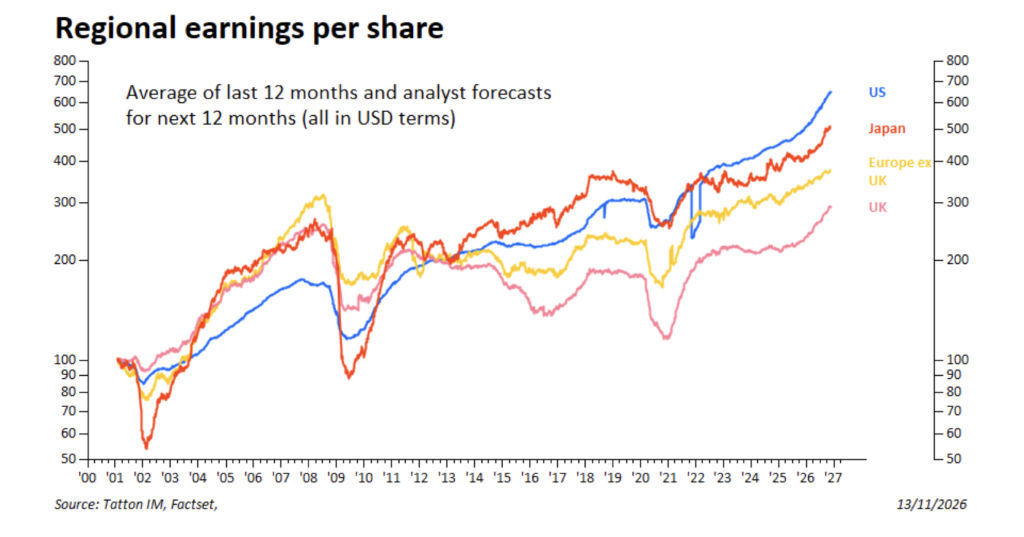
Growth is the best fuel for stocks. It is somewhat counteracted by what it means for bond markets, however. Real (inflation-adjusted) government bond yields rose last week, in reaction to a recovery in growth expectations. That undid some of the gains we saw in bond prices (the inverse of yields) in previous weeks.
Higher ‘risk-free’ government bond yields also make risk assets like equities less attractive by comparison. That does not mean that share prices cannot go up – with strong earnings growth, they should – but it does make it hard for price-to-earnings valuations to increase. The good news is that we at least do not expect yields to go much higher than they already are, largely because equity markets have looked so fragile recently.
The mix of higher growth and higher bond yields provides a solid foundation for stock markets. Earnings growth should support equities, while higher borrowing costs discourage businesses and investor sentiment from running too hot.
Liquidity tightening means a bumpy ride
Real yields have climbed and central banks are hawkish (aiming for higher interest rates) compared to earlier in the year. That combination means tighter financial conditions, and less liquid financial markets in the short-term. We see the recent struggles in bitcoin and gold prices – two assets that typically act as liquidity drains – as evidence of that.
Less borrowed capital flowing around often leads to price volatility, fraying investor sentiment. Earnings growth should give markets plenty of fuel, but liquidity conditions are a headwind. In that environment, investors are also more prone to being spooked by geopolitics.
This is where the Middle East limbo comes back into the story. Markets seem to have all but moved on from the US-Iran war and oil prices have dropped sharply since the US Midterms at the start of November, but Donald Trump took to Truth Social this week to announce: “We don’t need a deal with Iran.” There are also some rumours that Israel might strike Iran on its own, possibly in an attempt from Prime Minister Netanyahu to stay in power via an emergency unity government.
We should also bear in mind that European natural gas prices have not fallen in line with crude oil recently. With gas storage at seasonal lows on the continent, that could mean a tough winter.
These factors point to a potentially bumpy ride in markets, even if corporate earnings take us to a good destination. This week, we have the long-awaited IPO of AI model provider Anthropic, as well as Nvidia’s third quarter results. Both will test investor sentiment, and hopefully show it remains healthy.
This week’s writers from Tatton Investment Management:
Lothar Mentel
Chief Investment Officer
Jim Kean
Chief Economist
Astrid Schilo
Chief Investment Strategist
Isaac Kean
Investment Writer
Important Information:
This material has been written by Tatton and is for information purposes only and must not be considered as financial advice. We always recommend that you seek financial advice before making any financial decisions. The value of your investments can go down as well as up and you may get back less than you originally invested.
Reproduced from the Tatton Weekly with the kind permission of our investment partners Tatton Investment Management
Who are Vizion Wealth?
 Our approach to financial planning is simple, our clients are our number one priority and we ensure all our advice, strategies and services are tailored to the specific individual to best meet their longer term financial goals and aspirations. We understand that everyone is unique. We understand that wealth means different things to different people and each client will require a different strategy to build wealth, use and enjoy it during their lifetimes and to protect it for family and loved ones in the future.
All of us at Vizion Wealth are committed to our client’s financial success and would like to have an opportunity to review your individual wealth goals. To find out more, get in touch with us – we very much look forward to hearing from you.
The information contained in this article is intended solely for information purposes only and does not constitute advice. While every attempt has been made to ensure that the information contained on this article has been obtained from reliable sources, Vizion Wealth is not responsible for any errors or omissions. In no event will Vizion Wealth be liable to the reader or anyone else for any decision made or action taken in reliance on the information provided in this article.
