


Market Update: Sentiment rollercoaster
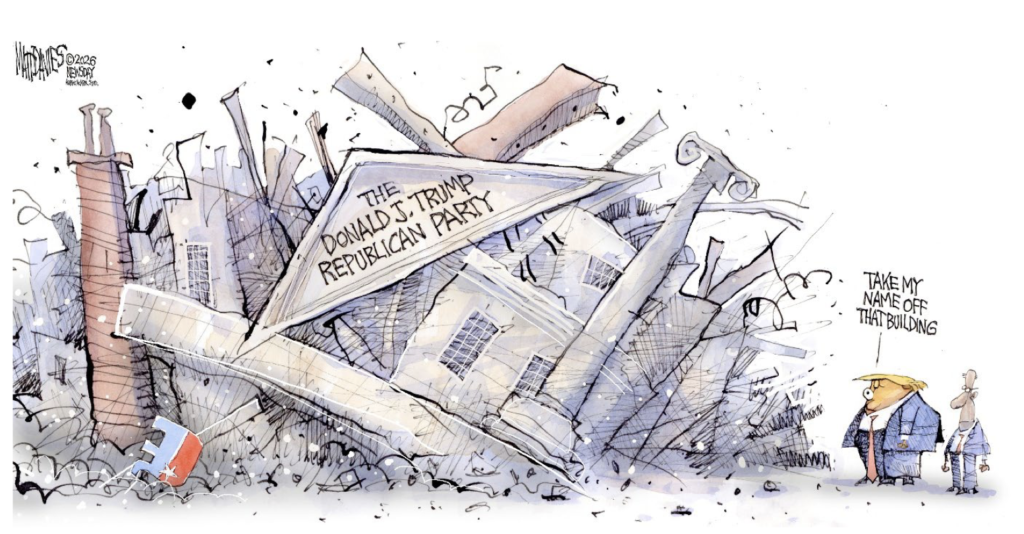
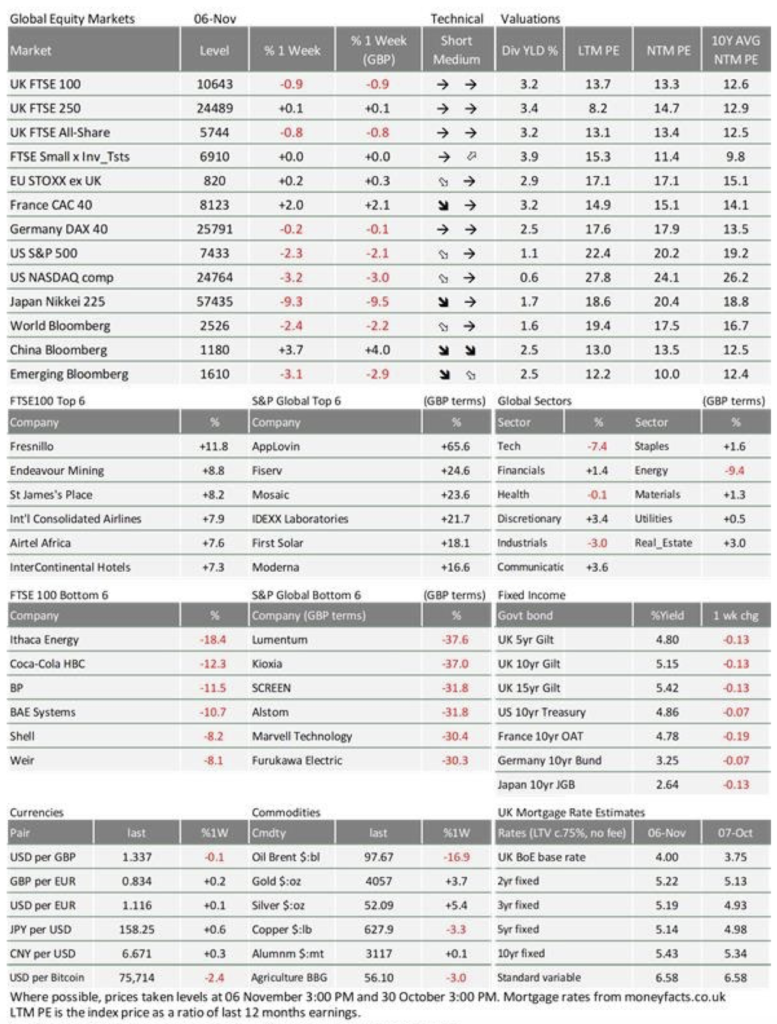
Thursday saw a rout in global tech stocks. US equities suffered their worst daily losses since the “Liberation Day” tariffs in April 2025, and selling continued in Asian markets on Friday morning. Markets recovered somewhat once US trading opened this afternoon – helped by a stronger-than-expected US employment report – but investors are clearly anxious about the durability of AI growth. This panic was brought on by the Democratic party’s resounding victories in the US midterm elections – with many elected on anti-datacentre platforms.
A bout of volatility does not help investors’ fragile sentiment. But we believe the narrative of an ‘AI bubble finally bursting’ is overdone.
Markets relieved that the elections weren’t challenged
The initial reaction to the US election results – Democrats winning both houses of Congress and several state governorships – was positive. Stock and bond prices gained in tandem, while oil prices dropped below $100 per barrel for the first time since September.
Bond yields, the inverse of prices, gained slightly on Friday afternoon. That followed news that the US added 165,000 jobs in October, more than double the 65,000 expected (stronger growth should mean higher ‘risk-free’ government yields). Yields are still significantly down from a few weeks ago, however.
Oil’s fall might be down to the fact that the rumoured post-election attacks on Iran have not (yet) materialised. Lower yields could just be a reaction to oil prices (since energy price inflation factors into yields) or it could be the expectation that a split between the White House and Congress will frustrate any budgetary measures, curtailing extra spending.
More likely, markets were just relieved that Trump did not challenge the election results. The president quickly accepted his Republican party’s emphatic defeat and distanced himself from losing candidates. That explains the initial burst up in equities too. Markets were probably more nervous about potential election chicanery than we realised.
There is also the sense that Trump, a ‘lame duck’ president without congressional control, can no longer disrupt markets like it used to. That is probably true, but there are still risks. Historically, lame duck presidents focus more on foreign policy, as they are unable to exercise domestic power. That does not bode well for the Middle East oil crisis. An opposition-controlled Congress also makes US government shutdowns (failure to agree budget bills, resulting in lapsed government funding) more likely. Still, one uncertainty down is a boon.
Voters want datacentre moratorium; how do investors feel?
With the election behind us markets quickly turned to what Democrat control might mean for the AI infrastructure buildout. Democratic state governors were elected on anti-datacentre platforms in Texas, Georgia and Ohio – the three states where AI infrastructure is building most rapidly. On Thursday, panic spread that this could end the AI earnings boom that has sustained global markets and economic growth for years.
As the sell-off deepened, markets interpreted American voters as rejecting not just datacentres, but also the US tech companies that had previously aligned themselves with Trump. Losses for Elon Musk’s Tesla (-11% on Thursday) and SpaceX (-9%) backed up that feeling. Trump quickly blamed the Democrats’ victories – even telling American voters, “you only have yourselves to blame!”
However, if we focus on policy rather than sentiment, a datacentre slowdown might not be a bad thing for AI firms. Indeed, it is arguably what investors have been calling for. AI-related shares have been fragile recently, amid supposed reports of slowing demand for AI computing power. Markets have punished companies that announce large debt-fuelled AI spending and rewarded those with stronger near-term cashflows.
If Democratic governors enact their proposed moratorium on new datacentre planning approvals, that could benefit the so-called hyperscalers (large cloud computing firms). Datacentre expansion moratoria would potentially block future projects being approved – but the many projects already approved would still be built. The result would then be a scarcer market for ‘compute’ and possibly a lid on future building costs. That is supportive for hyperscalers’ bottom lines, even if it is not for US growth.
We would also note that the AI model providers like Anthropic and OpenAI have been calling for a slowdown in ‘frontier’ models, citing existential risks. If there is less infrastructure to run those models on, they might get their wish.
Lower risk of overheating, lower bond yields
As expected, the Bank of England (BoE) raised interest rates by 0.25 percentage points on Thursday. The BoE’s accompanying commentary and forecasts were more hawkish (preferring higher rates) than investors predicted, however. We could see another hike next month, with Governor Andrew Bailey making it clear that global energy prices are dictating BoE policy.
Yields on long-term UK government bonds (gilts) bounced ever-so-slightly in response, but are still sharply down from a month ago. The sensitivity to global conditions that Bailey highlights has actually helped gilts in that time. Recently falling oil prices and falling US bond yields have driven gilts. This is testament to the fact that global bond markets are truly global, and not always that reactive to local factors (despite what budget-watchers might say).
Even French government bond yields are down – despite France’s parliament yet again failing to agree a new budget last week. All Prime Minister Lecornu’s remaining options for the budget are politically perilous, and France’s fiscal position remains stretched. But French bond investors seem less worried than they were – simply because global bond sentiment has improved.
Lower oil prices are an important part of the drop in global yields – so the Middle East is still a point of tension for markets. But the other crucial factor behind the recent drop in yields has been the changing growth outlook. Markets feel that there is now a lower risk that the debt-fuelled AI infrastructure splurge causes the global economy to overheat. Once the current volatility subsides, that will likely be seen as a relief.
This week’s writers from Tatton Investment Management:
Lothar Mentel
Chief Investment Officer
Jim Kean
Chief Economist
Astrid Schilo
Chief Investment Strategist
Isaac Kean
Investment Writer
Important Information:
This material has been written by Tatton and is for information purposes only and must not be considered as financial advice. We always recommend that you seek financial advice before making any financial decisions. The value of your investments can go down as well as up and you may get back less than you originally invested.
Reproduced from the Tatton Weekly with the kind permission of our investment partners Tatton Investment Management
Who are Vizion Wealth?
 Our approach to financial planning is simple, our clients are our number one priority and we ensure all our advice, strategies and services are tailored to the specific individual to best meet their longer term financial goals and aspirations. We understand that everyone is unique. We understand that wealth means different things to different people and each client will require a different strategy to build wealth, use and enjoy it during their lifetimes and to protect it for family and loved ones in the future.
All of us at Vizion Wealth are committed to our client’s financial success and would like to have an opportunity to review your individual wealth goals. To find out more, get in touch with us – we very much look forward to hearing from you.
The information contained in this article is intended solely for information purposes only and does not constitute advice. While every attempt has been made to ensure that the information contained on this article has been obtained from reliable sources, Vizion Wealth is not responsible for any errors or omissions. In no event will Vizion Wealth be liable to the reader or anyone else for any decision made or action taken in reliance on the information provided in this article.
