


Market Update: Bond yields back on the market stage
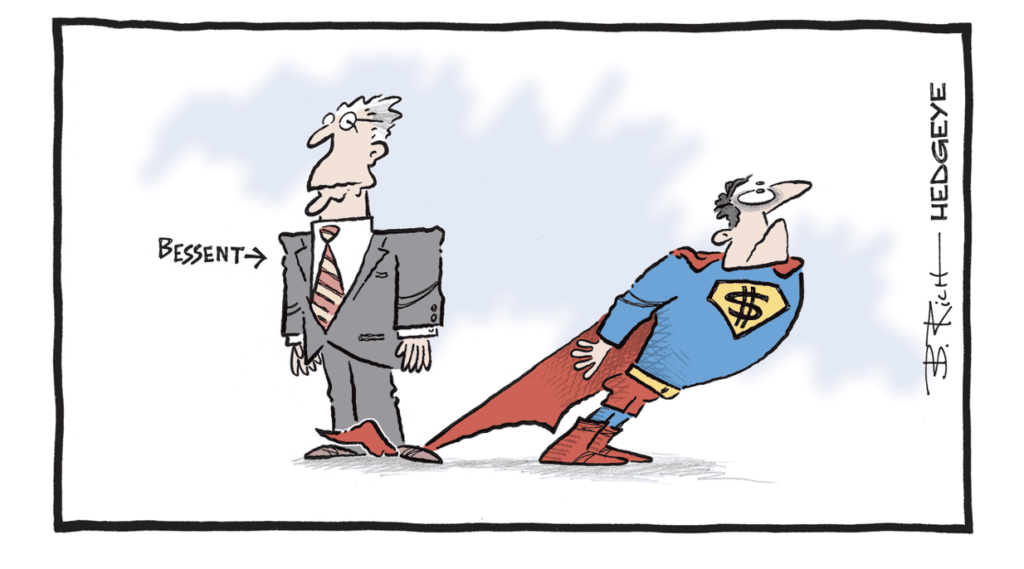
The might of the bond markets returns
Last week was the first time this summer where we observed the seasonal lack of trading liquidity becoming an issue in markets. In last week’s market update, we titled ‘Hot weather, chilled markets’ and wrote that the “market-moving narratives are basically the same as they have been for weeks: strong tech earnings, receding energy price fears and lingering anxiety around high government bond yields”.
Those rising government bond yields finally became too high for equity investors to ignore. Despite the previous week’s rather tame inflation data, yields for longer maturity bonds had moved higher and carried on rising through Monday and into Tuesday. The inability of the market to respond to fundamentally supportive data is probably because of the reduced market liquidity during these summer months.
However, lacking liquidity had not seemed to be a problem for equities and other asset classes up until this point. And within the bond market itself, traders had said there was no sign of distress.
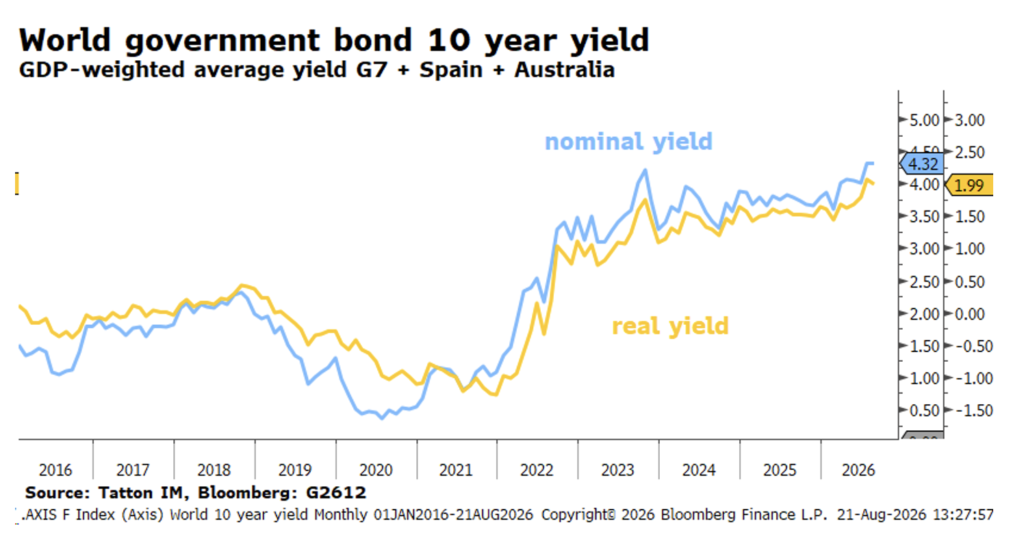
Nevertheless, as the graph below shows, global 10-year government bond yields reached a new post-pandemic aggregate high and are within a few basis points of a 20-year peak. This is especially true for real (inflation-adjusted) yields which are now essentially at 2% (after being negative for an extended period of time during the low interest period until after the pandemic).
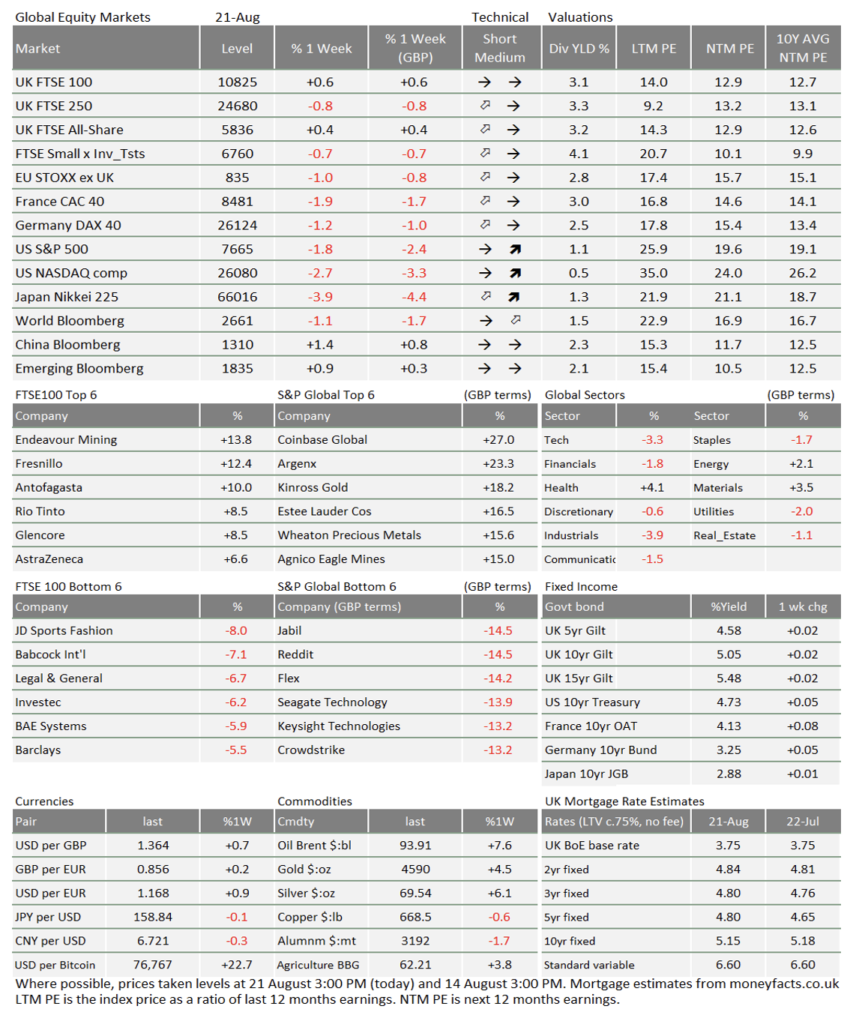
Equity markets took notice. There was a broad sell-off which began on Monday and kept going. This has been most apparent in US and Japanese stocks; Europe has held up better.
Bond traders may not have seen much of a problem with market function but, clearly, the US Treasury was less sanguine. Scott Bessent, the Treasury Secretary, announced on Wednesday that the US government would (at least) double buybacks, where it purchases its own bonds before they mature, of in the 10-to-30-year range. Only two weeks ago, the department announced their expected schedule over the next three months which included a buyback program of $38bn, so we should now expect at least $74bn.
The initial outcome of this announcement was a sharp 0.12% fall in longer bond yields, only for them to rise back on Thursday by 0.06%. Equities rallied somewhat on Wednesday but again fell back yesterday. Perhaps the most persistent outcome was for the US dollar to weaken against most currencies although the Japanese Yen benefited the least of all the majors. The Euro was strongest, followed by Sterling.
Were Bessent’s announcements to have been purely about near-term bond liquidity problems, the implications might be ephemeral (although it will be interesting that US Fed chair Kevin Warsh’s agenda regarding potential balance sheet reduction could be seen as undermined by the other US finance official). However, on Thursday Bessent told CNBC that “we are announcing … an increased focus on fiscal consolidation.” Separately he said that President Donald Trump had tasked himself and Budget Director Russ Vought in that initiative. Bessent said we should expect more details in the next few days.
Looking back to when Bessent was being appointed, he talked of the 3-3-3, a real growth level of 3%, an extra 3 million barrels per day of US crude oil production, and a reduction in the federal budget deficit to 3% per year. While he is still shy of the growth target, the US economy has done well thanks to the AI hyperscalers increasing investment. Increased energy production may well be said to be equivalent to 3 million barrels of new oil even if actual oil production has probably flatlined. But, in respect of the budget deficit, he has demonstrably failed (chart below).
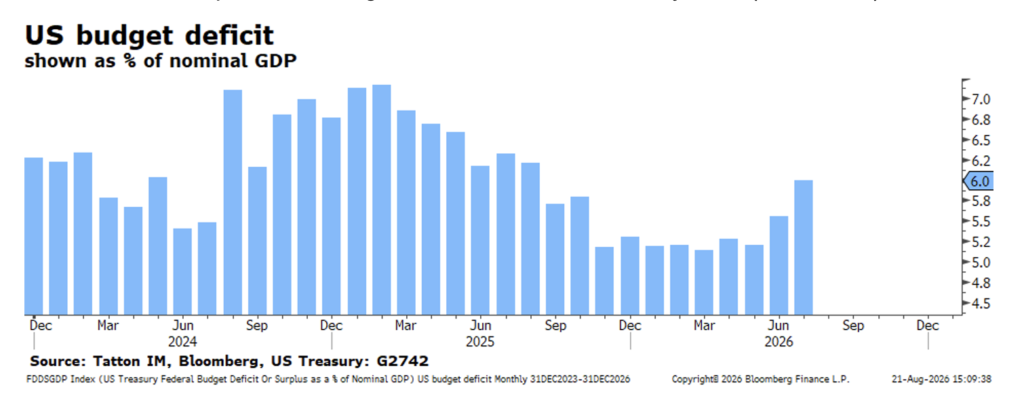
The budget deficit never got below 5% even when the tariff revenues were in full flow and lastweek the total outstanding US central government debt passed $40 trillion. Now, the political impetus is back and incentivised by the rising interest cost ($1trn/year). In the past, Trump has been said to be unconcerned about debt levels, but this cannot be said of those that now surround him, and they have means of gaining his attention and backing.
For the Republicans ahead of the mid-terms, this is an issue they can get behind considerably (as long as their own local areas are not impacted). While tax cuts are not likely to be promised in return for government spending cuts, the prize would be the prospect of lower mortgage rates. Currently the thirty-year mortgage is back above 6.75% having come close to 6% at the start of the year. The residential housing market has been awful since 2022 and now could be said to be close to death. Housing is a better signal of growth for most voters than unpopular spending on datacentres.
A new set of policies designed to effectively set the government deficit on a path to reduction could be transformative for bond investors, enabling buyers to emerge despite the continued strong capex-related economic growth.
It also has interesting implications for the UK which, after June’s rather positive government balance data, had yet another disappointing increase in expenditures to show a monthly deficit of £1.8bn. July tax receipts were buoyant (July and January are the big receipt months) and revisions helped previous months to show a slightly better outcome than the OBR forecasts but spending continues to be difficult to contain.
The Western political agenda appears to be shifting towards fiscal discipline once again. This may be difficult for a new Burnham government to deal with but, on the other hand, it does offer benefits. If US yields start to decline again it is highly likely that UK yields will follow, even if by not as much. Meanwhile, it might be a little easier to corral the left of the Labour Party if the pressure is an external rather than internal discipline.
And it is still possible that UK growth will remain strong enough to keep tax receipts growing (growth being the best way to achieve a fall in the relative measures). Business sentiment remains positive as August’s Flash PMIs showed (a number above 50 indicates expansion), with only a small fall in the manufacturing measure to 51.5 from 51.9; services rose to 52.8 from 52.1; the overall composite showed a gain to 52.5 from 52.2. The GfK Consumer Confidence sentiment measure also improved to -14 (it ranges between -49 and +9 so -20 is probably the equivalent to a true zero and this month’s figure is equivalent to +8).
This week is the last week of the summer quiet period (and seasonal illiquidity). On Wednesday, Nvidia releases its results which will surprise nobody even when they “surprise” on the upside; all eyes will be on footnotes which might signal “circular financing”; and the US Federal Reserve holds its annual conference for global central bankers at Jackson Hole, Wyoming, where we will be listening for signals of policy change regarding the Federal Reserve balance sheet management. Given the Treasury is now buying back more to keep rates down, will the Fed Chairman Warsh want to sell them some bonds?
A final note on liquidity; we mentioned the US dollar’s fall after Bessent’s announcement. In terms of liquidity signals, a weaker dollar is good for global assets. Another positive is that gold is up and Bitcoin has surged (+23%!). The summer fall in liquidity may be over in quite a big way.
This week’s writers from Tatton Investment Management:
Lothar Mentel
Chief Investment Officer
Jim Kean
Chief Economist
Astrid Schilo
Chief Investment Strategist
Isaac Kean
Investment Writer
Important Information:
This material has been written by Tatton and is for information purposes only and must not be considered as financial advice. We always recommend that you seek financial advice before making any financial decisions. The value of your investments can go down as well as up and you may get back less than you originally invested.
Reproduced from the Tatton Weekly with the kind permission of our investment partners Tatton Investment Management
Who are Vizion Wealth?
 Our approach to financial planning is simple, our clients are our number one priority and we ensure all our advice, strategies and services are tailored to the specific individual to best meet their longer term financial goals and aspirations. We understand that everyone is unique. We understand that wealth means different things to different people and each client will require a different strategy to build wealth, use and enjoy it during their lifetimes and to protect it for family and loved ones in the future.
All of us at Vizion Wealth are committed to our client’s financial success and would like to have an opportunity to review your individual wealth goals. To find out more, get in touch with us – we very much look forward to hearing from you.
The information contained in this article is intended solely for information purposes only and does not constitute advice. While every attempt has been made to ensure that the information contained on this article has been obtained from reliable sources, Vizion Wealth is not responsible for any errors or omissions. In no event will Vizion Wealth be liable to the reader or anyone else for any decision made or action taken in reliance on the information provided in this article.
