


Market Update: Markets making the best of it
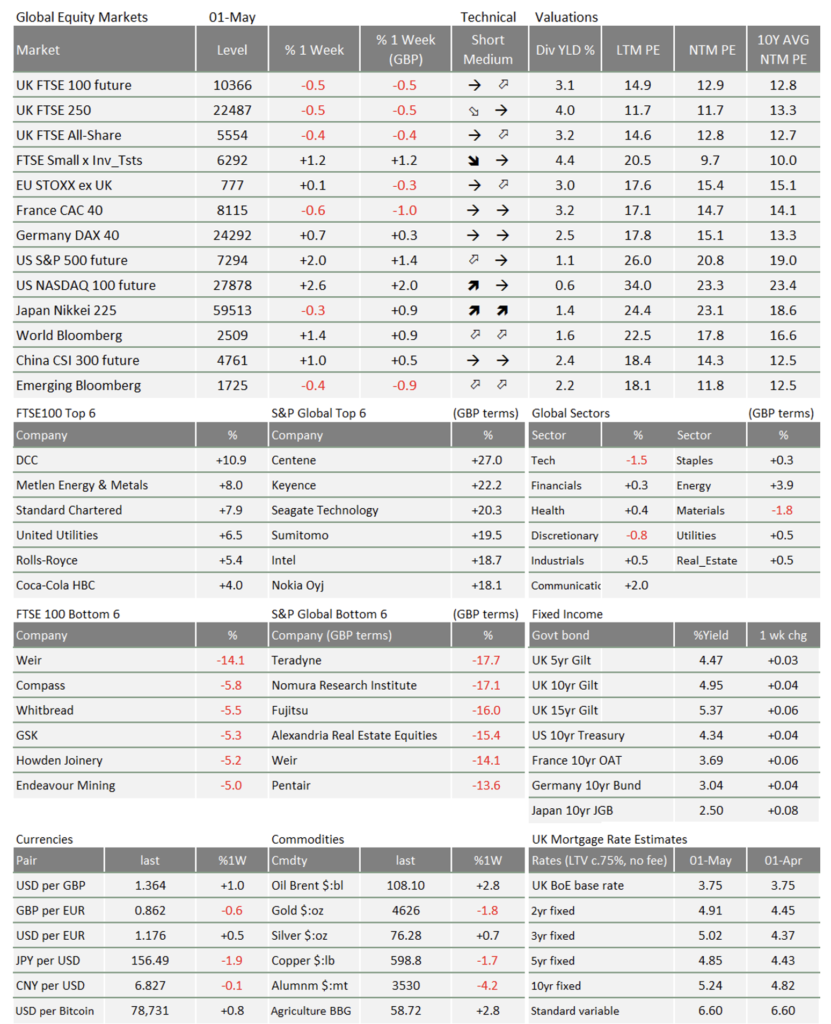
The risks we wrote about last week keep rising. The continued US blockade of the Strait of Hormuz, along with reports that the US might restart attacks, sent oil prices above $120 per barrel in midweek trading. They have since settled down to around $105pb. UK and European stocks are slightly down over the week in sterling terms, but US equities were higher again as the Friday session started. Japan and China were flat as they began “Golden Week” holidays, with help from a sharp rally in the Japanese Yen. In aggregate, global equities have gained slightly.
Bonds, on the other hand, have been volatile, with 10-year yields touching 2026 highs in most markets. UK bonds remain more sensitive than other markets, with the 10-year rising above 5%.
Stable equities tell us that investors do not think the oil shock is insurmountable for 2026 growth. That view is backed by healthy US and UK economic data, recorded since the conflict began. Volatile oil prices mean that view requires a fairly quick end to the energy crisis. Yet again, time is not on our side. Bond markets seemed more aware of this less pleasant dynamic.
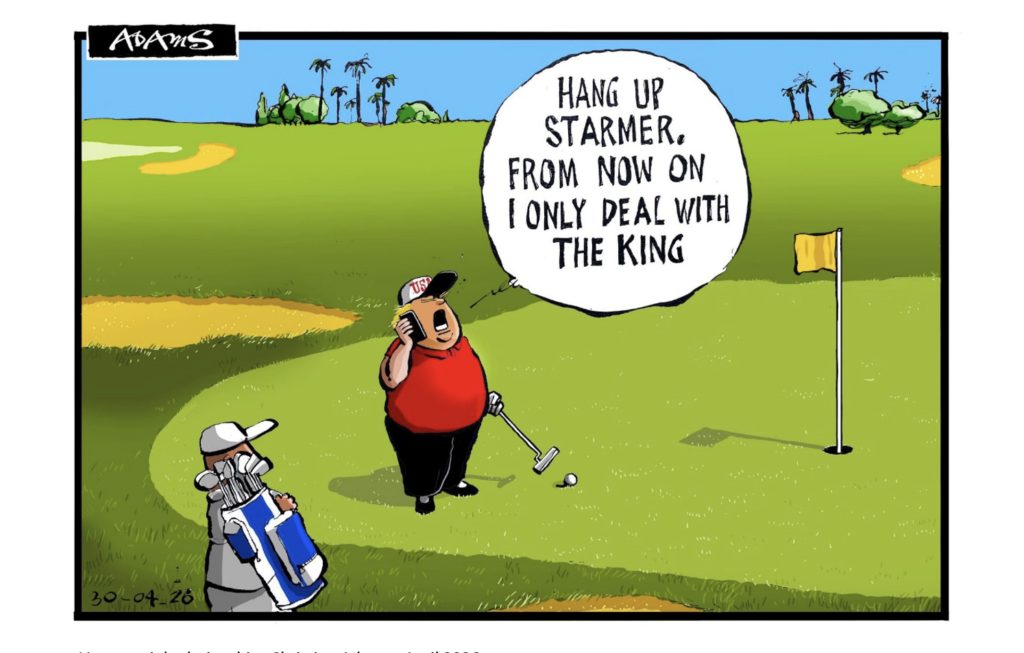
Blockades are no place for a TACO
Washington is now cutting off Iran’s oil revenues, rather than attacking outright. This is not the TACO approach (Trump Always Chickens Out) we are used to. The White House is effectively telling oil markets to stomach higher prices until Tehran relents on US demands, through some regime change or at least giving up their nuclear ambitions.
Supposedly, this could happen within a few weeks. Iranian oil storage is reportedly two weeks away from full capacity, at which point production might have to wind down, damaging long-term production capacity. Regardless, the lack of oil revenues saps Tehran’s ability to fund its state and military. Judging by markets’ relative calm, investors think it is likely this will happen soon. We see logic there, but it is still a gamble.
We suspect the situation will come closer to a head later this month. Trump is set to visit Beijing on 14th May for his summit with Xi Jinping, and Iran will certainly be top of the agenda. We suspect that allowing the flow of Iranian oil, prior to the blockade, was partly a way to avoid antagonising China (the destination for much of Iran’s oil exports). China has been relatively quiet about the blockade so far, perhaps awaiting the summit.
Current oil prices are up, but long-term pricing has stayed pretty stable. That is helped by the UAE leaving OPEC last week. There are many reasons for the exit, but they probably want to produce and sell a lot of oil at high prices, as soon as they are able. The global oil market was in oversupply before this conflict, and the UAE news suggests that, over the long-term, that has not changed.
Central banks want to look through inflation – but can they?
Higher oil prices pushed up short-term bond yields. But real (inflation-adjusted) yields also climbed, and there was a curious shift in demand from longer to shorter-term bonds – despite the yield shift being caused by short-term inflation expectations. Bond investors are seemingly worried about volatility and have a higher cash preference.
Interest rate expectations moved up – but all the major central banks kept rates steady last week. All acknowledged that monetary policy cannot influence the underlying energy shock (implicitly, in the Federal Reserve’s case).
Bank of England Chief Economist Huw Pill was the sole vote against holding rates still, because he thinks UK growth is faster than their own research indicates. Other hawks such as Catherine Mann were prepared to wait, but will probably vote for a rise in June. Governor Andrew Bailey said there was “a good, good deal of space available to accommodate” inflation pressures.
Some Federal Reserve committee members dissented over a continued referral to an easing bias in the Fed’s statement. Division at the Fed may be exacerbated by outgoing chair Powell’s desire to stay on as governor. Still, US policymakers will probably see the current situation as a temporary price spike, not a price spiral.
ECB President Lagarde effectively prepared markets for a June rate hike. The European economy could really do without that, but Lagarde feels she has little other choice. Europe is particularly vulnerable to an energy crunch (though it was notable that both gas and electricity prices did not rise as much as oil last week) and the ECB cannot afford to let inflation become embedded.
Energy independence gives the US fewer supply-side problems. But, in some respects, its resilient economy – with stable employment and consumption – should make the Fed more nervous. Compared to Europe, maintaining growth through a price shock provides fuel for sustained inflation. Incoming Fed chair Warsh, picked by Trump to cut rates, has a difficult first few months ahead.
One way or another, it won’t always be like this
US outperformance is also about resilient corporate earnings. The tech mega-caps revealed stellar profit growth, yet again. They plan to keep spending on AI but, worryingly, that seems now to be more about the higher costs than it is about scaling up. Plans to spend more but getting less in return are what severely hurt Meta shares last week.
Earnings growth forecasts for the next 12 months remain strong, but we note that the forecast expansion for the 12 months thereafter (a measure of earnings acceleration) points to slower growth. This measure climbed last year, thanks to big tech’s AI spending spree, but it is now coming down. There is no suggestion that it will keep falling, but plateauing growth is a challenge for tech stocks with high price-to-earnings valuations.
To summarise, last week was effectively a microcosm of the last two months: US-Iran tensions have cranked up further, but central banks remain patiently neutral while the earnings reports are strong. Markets therefore look past the increased growth risks.
It cannot always be like this. Those sustaining factors will increasingly struggle to prevail if oil prices stay high for the long-term. Higher bond yields are making equities less attractive by comparison. If we get a week without supportive growth news, we could get a market setback.
This week’s writers from Tatton Investment Management:
Lothar Mentel
Chief Investment Officer
Jim Kean
Chief Economist
Astrid Schilo
Chief Investment Strategist
Isaac Kean
Investment Writer
Important Information:
This material has been written by Tatton and is for information purposes only and must not be considered as financial advice. We always recommend that you seek financial advice before making any financial decisions. The value of your investments can go down as well as up and you may get back less than you originally invested.
Reproduced from the Tatton Weekly with the kind permission of our investment partners Tatton Investment Management
Who are Vizion Wealth?
 Our approach to financial planning is simple, our clients are our number one priority and we ensure all our advice, strategies and services are tailored to the specific individual to best meet their longer term financial goals and aspirations. We understand that everyone is unique. We understand that wealth means different things to different people and each client will require a different strategy to build wealth, use and enjoy it during their lifetimes and to protect it for family and loved ones in the future.
All of us at Vizion Wealth are committed to our client’s financial success and would like to have an opportunity to review your individual wealth goals. To find out more, get in touch with us – we very much look forward to hearing from you.
The information contained in this article is intended solely for information purposes only and does not constitute advice. While every attempt has been made to ensure that the information contained on this article has been obtained from reliable sources, Vizion Wealth is not responsible for any errors or omissions. In no event will Vizion Wealth be liable to the reader or anyone else for any decision made or action taken in reliance on the information provided in this article.
