


Market Update: Steering round the iceberg
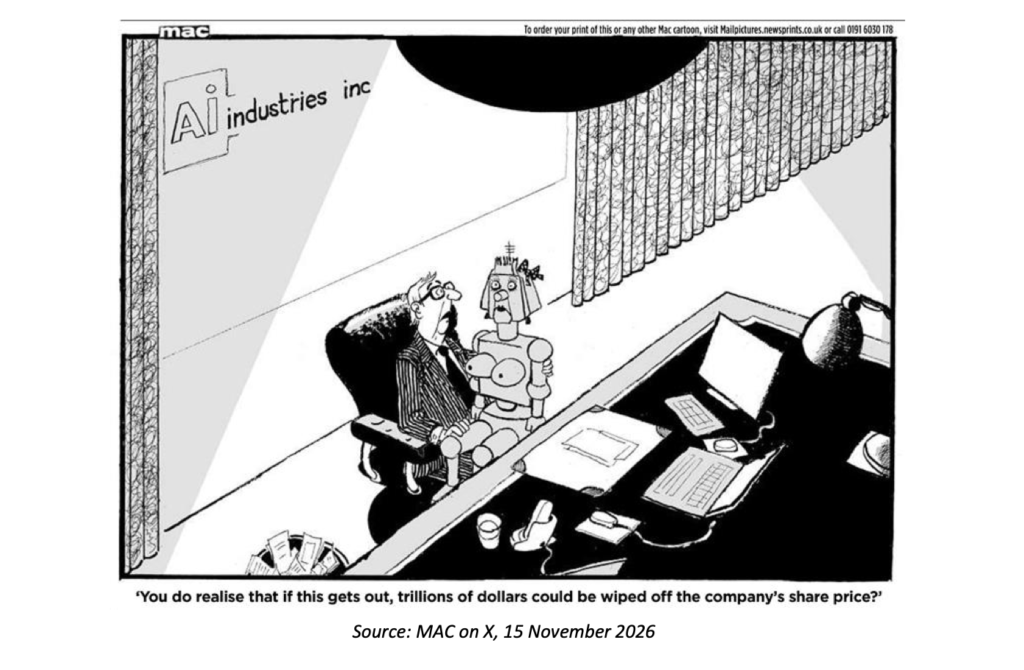
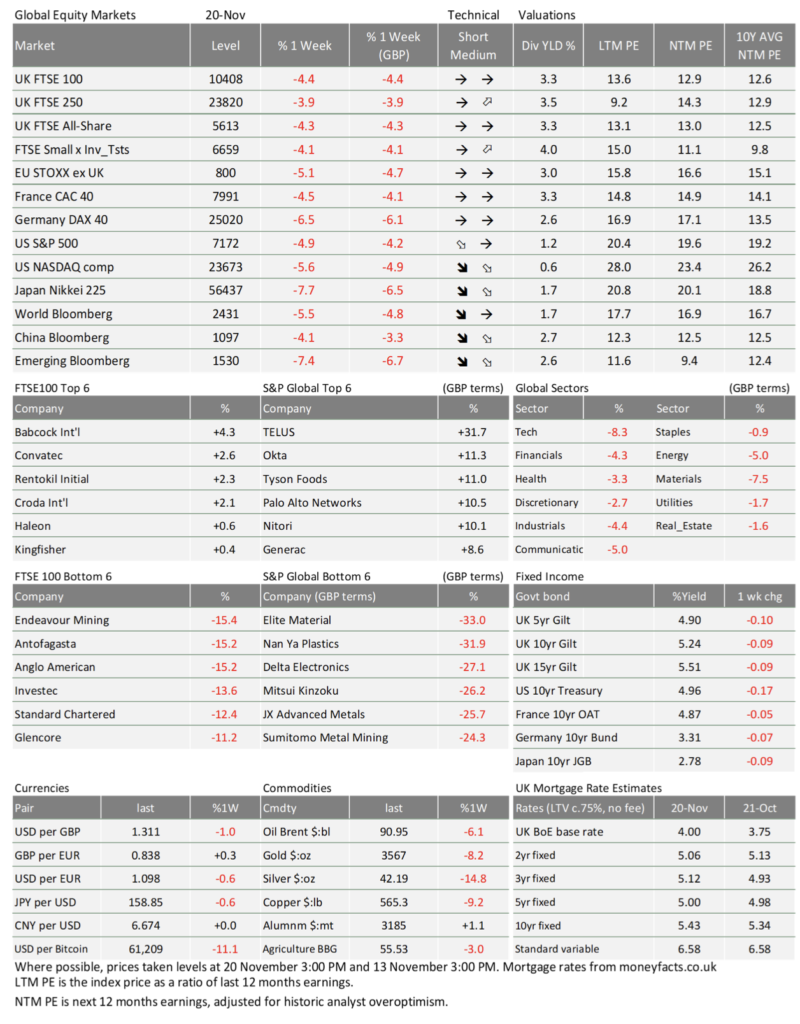
The initial public offering for AI company Anthropic will probably go down as a success. But broader global share prices dropped sharply last week, partly because of the IPO. Early in the week, UK and European markets, often seen as a hedge against the AI theme, actually fared worse than tech-heavy US indices (in sterling terms). Tech stocks then slumped after the new Anthropic shares debuted on Thursday.
We think this is mainly about tougher liquidity conditions. With less capital flowing around, risk assets can struggle, particularly when an IPO absorbs over $100bn in a single day. The good news is that liquidity tightening is more often a short(ish)-term problem. For the longer term, the sell-off looks like a sensible market reorientation.
On Friday, the UK and the EU have just agreed to harmonise certain rules on emissions, agriculture and movement – which we will cover next week.
Anthropic up; liquidity down
Even before the Jensen Huang scandal, investors were nervous about AI stocks. The turmoil at AI leader Nvidia added to those concerns, coinciding with a more than 10% drop in the tech-heavy Nasdaq 100 index. In the same period, one Federal Reserve governor publicly argued for a larger-than-usual interest rate rise, causing a pre-emptive tightening of financial liquidity. Markets are dry and investor sentiment is fragile. So, it might seem like bad timing for the largest IPO in history.
And yet, Anthropic’s stock market listing started very well, raising $107bn for the Claude maker (including a private placement led by Nvidia and Google) at a share price of $83, a fully diluted valuation (including convertible stock options) of over $2tn and an enterprise value (market cap plus debt) of about 35 times its expected 2026 sales. The first trade on the NASDAQ opened at $111.50, 34% higher than the listing price.
We said that the IPO would test sentiment and, in terms of share pre-orders, Anthropic passed with flying colours. That might seem hard to reconcile with broader equity market falls, but that just shows how tight liquidity conditions are right now. $107bn is an awful lot of capital to soak up. The IPO acted as yet another liquidity constraint on broader markets; Anthropic’s gain was others’ loss.
Seemingly, retail investors received a greater proportional allocation compared to institutional investors. But many retail investors were not particularly committed to long-term ownership. Vanda Research estimated that six out of seven retail Anthropic investors were “stags”, looking for immediate profit as soon as their allocation was known. The stock has fallen back considerably after the initial burst, to below $90 in European trading on Friday.
Nvidia’s financing role at risk
Investors’ preparedness to place orders for Anthropic was at odds with markets’ dented confidence, following the Nvidia affair. Nvidia was the world’s most valuable company earlier this month but has dropped down to third place (behind Apple and Microsoft) after losing more than 30% from its share price. Investors continue to think that life after Jensen Huang will be tough for the AI chip giant. This is not just about Huang’s personal influence: the company also announced it would stop selling AI chips to China, despite getting approval from the US government last year. Nvidia sold $2.4bn of approved chips to China in the third quarter of 2026 alone.
Not even a stellar earnings report was enough to turn things around for Nvidia. Results from Q3 showed revenues doubled from the year before, and the company projected better-than-expected sales of $130bn. The only concern was that Nvidia projected a slight dip in profit margins at the start of 2027, due to rising costs, though overall earnings growth is still expected to be strong.
The decline of Nvidia’s share price is a problem for broader US chipmakers. Not only has Nvidia supplied the AI buildout in recent years; it has increasingly financed the buildout too. Under Huang, the tech giant was willing to lend to some fairly risky AI companies at relatively cheap rates.
Its role in the Anthropic private placement shows that the post-Huang Nvidia is still willing to finance the AI boom, but investors worry that might not last. Some financial commentators have wondered whether Nvidia’s scandal might therefore act as a clearing event for markets: Nvidia reduces its lending, AI firms struggle for capital and then the overextended players get found out. In Warren Buffett’s words, “You don’t find out who’s been swimming naked until the tide goes out.”
We do not see much sign of that hypothetical risk playing out right now. Tech share price-to-earnings valuations are falling – down to what many would consider more reasonable – but it is too early to see any naked swimmers.
Waiting for the rest of the economy to catch up
The fall in valuations for AI firms tells you that investors overall are fairly sceptical about the durability of the AI earnings boom (the appetite for Anthropic’s IPO notwithstanding). As we have argued before, this is what separates the current AI investment theme from 2000s dotcom-style irrational exuberance. Arguably, a knockback on tech optimism is healthy.
If the current episode does lead to less borrowing and reduced big tech investment, that could eventually lower interest rates. The fact that central banks’ desire to react faster and firmer to inflation data does not mean they will stay hawkish (preferring higher rates) over the long-term. It should also mean they are quicker to cut if growth slows.
If that does happen, then the parts of the economy which have been hampered by high interest rates – like housebuilders and consumer-related stocks – would get a long-awaited boost. Interestingly, long-term bond yields dropped sharply in the last few days. We suspect that rates could fall far enough and quickly enough for these sectors to generate investor interest.
In the meantime, a drop in tech valuations is making stocks cheaper without significantly slowing the real economy. For over a year, bearish commentators have warned that markets are heading for an AI iceberg. But it now looks like investors have changed course early enough to steer around it.
This week’s writers from Tatton Investment Management:
Lothar Mentel
Chief Investment Officer
Jim Kean
Chief Economist
Astrid Schilo
Chief Investment Strategist
Isaac Kean
Investment Writer
Important Information:
This material has been written by Tatton and is for information purposes only and must not be considered as financial advice. We always recommend that you seek financial advice before making any financial decisions. The value of your investments can go down as well as up and you may get back less than you originally invested.
Reproduced from the Tatton Weekly with the kind permission of our investment partners Tatton Investment Management
Who are Vizion Wealth?
 Our approach to financial planning is simple, our clients are our number one priority and we ensure all our advice, strategies and services are tailored to the specific individual to best meet their longer term financial goals and aspirations. We understand that everyone is unique. We understand that wealth means different things to different people and each client will require a different strategy to build wealth, use and enjoy it during their lifetimes and to protect it for family and loved ones in the future.
All of us at Vizion Wealth are committed to our client’s financial success and would like to have an opportunity to review your individual wealth goals. To find out more, get in touch with us – we very much look forward to hearing from you.
The information contained in this article is intended solely for information purposes only and does not constitute advice. While every attempt has been made to ensure that the information contained on this article has been obtained from reliable sources, Vizion Wealth is not responsible for any errors or omissions. In no event will Vizion Wealth be liable to the reader or anyone else for any decision made or action taken in reliance on the information provided in this article.
