


Market Update: New month, new dynamics

Regaining confidence after July’s drought
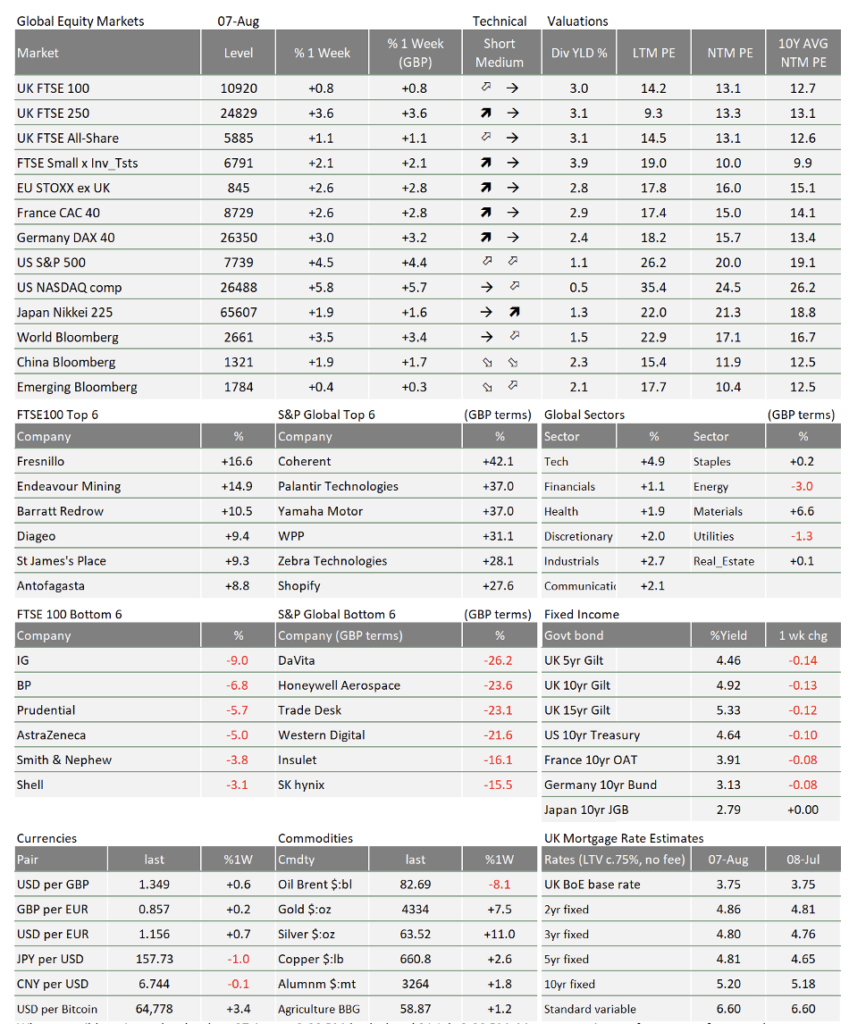
The announcement of yet another Iran deal buoyed stock markets last week. Iran and Oman reportedly agreed a new shipping route through the Strait of Hormuz, which would temporarily solve the issue that collapsed the US-Iran ceasefire last month. The normalisation of global energy supplies still depends on negotiations between Washington and Tehran, but markets reacted with their now typical optimism: oil prices fell to $80 per barrel, and US stocks broke new all-time highs. It all reversed somewhat late on Thursday after details of the deal unveiled features that would make it unacceptable to the US, given their provocative nature. Nevertheless, according to the US president on Friday morning, the Strait of Hormuz is ‘sort of open’.
The global energy outlook is essentially the same as it was in mid-June, with basically the equivalent risks. But, with each new back and forth in the Strait of Hormuz, the impact on markets dampens.
Yen-tervention a prelude to currency volatility?
The other big news story last week was the US central bank – the Federal Reserve (Fed), on behalf of the Treasury, teaming up with Japan’s finance ministry last Friday to support the value of the yen. If the Iran news was more of the same, the yen intervention was a new dawn. It was the first joint currency intervention between American and Japanese authorities in nearly 30 years, but it felt even more historic: not since the build-up to the 1985 Plaza Accord have Washington and Tokyo so explicitly coordinated to address perceived currency imbalance.
For Japan, it means that interest rates will probably go up. The Bank of Japan (BoJ) has been reluctant to do so despite inflation pressures taking hold. However, it is unlikely that the US Treasury would agree to such an intervention without at least an implicit agreement to address the underlying trade imbalance. There is good reason for that: after nearly 30 years, Japan’s era of disinflation is finally over, its domestic growth is strong and its current account surplus (Japan exports more than it imports) is so high that it needs to be addressed.
Japanese investors do not own enough of their own assets, with Japanese capital often flowing into other markets. Indeed, that other imbalance on the capital flow side is one of the reasons for the yen’s persistent weakness. If the intervention encourages Japanese citizens to buy more of their own assets – particularly Japanese bonds, at some of the most attractive real yields in decades – then the currency could make a turn for good.
For the world, the yen-tervention represents a decent chunk of liquidity injected into global markets. The Fed and the BoJ put billions of dollars and euros into the financial system, which has boosted market liquidity and raised investors’ spirits. The only downside is if the yen’s sharp rise leads to more volatility in global currency markets. That would make any volatility in global stock prices feel much worse for investors.
Higher yields mean stocks aren’t cheap
As well as better liquidity, there are fundamental reasons for investors to get excited. Corporate earnings growth is strong around the world – even if US earnings are not quite as strong as advertised. There are also signs that the AI infrastructure splurge is boosting the more traditional sectors of the economy like construction. Broad improvement in earnings means that stocks’ price-to-earnings valuations have fallen, even with last week’s jump up in share prices.
That makes stocks look good value. The only problem is restrictively high government bond yields: nominal yields fell last week, in line with lower oil prices, but real (inflation-adjusted) yields are still at their highest level since the start of the century. Higher real yields make stocks less attractive by comparison. If you adjust equity valuations for real yields, in fact, stocks do not look quite as cheap.
Theoretically, higher real yields should mean that bond markets expect stronger economic growth, but we doubt that is why yields have risen. The explanation could just be that there is intense demand for borrowing – from both governments and AI companies – leading to more bond supply than demand. In any case, historically high yields are still not attracting enough bond buyers and are certainly not high enough to pull investors out of equities.
Fragile but optimistic
That does not mean equity investors could not eventually be tempted. If real yields rose even further from here – and last month’s bout of share price volatility resumes – stocks could sell off sharply to fund bond purchases. That would be especially true if currencies became volatile too. This process could result in another painful episode for investors.
That hypothetical scenario is a risk, but not the base case. More likely is that last week’s good mood continues, for the rest of the summer at least. July’s flushing out of highly geared tech speculators will perhaps prove to have been a beneficial cathartic moment, as last week’s market trading data suggests that investors are rebuilding their ‘long’ equity positions, meaning they are positioning for a longer rally. Volatility is falling and liquidity is improving, as shown by the rise in gold and Bitcoin prices.
Markets feel fragile because of the various unresolved issues around, and the experience of what has come before during outsized infrastructure buildout periods. But the economic fundamentals are strong, and market dynamics are supportive right now. Hopefully, it will be a long summer.
This week’s writers from Tatton Investment Management:
Lothar Mentel
Chief Investment Officer
Jim Kean
Chief Economist
Astrid Schilo
Chief Investment Strategist
Isaac Kean
Investment Writer
Important Information:
This material has been written by Tatton and is for information purposes only and must not be considered as financial advice. We always recommend that you seek financial advice before making any financial decisions. The value of your investments can go down as well as up and you may get back less than you originally invested.
Reproduced from the Tatton Weekly with the kind permission of our investment partners Tatton Investment Management
Who are Vizion Wealth?
 Our approach to financial planning is simple, our clients are our number one priority and we ensure all our advice, strategies and services are tailored to the specific individual to best meet their longer term financial goals and aspirations. We understand that everyone is unique. We understand that wealth means different things to different people and each client will require a different strategy to build wealth, use and enjoy it during their lifetimes and to protect it for family and loved ones in the future.
All of us at Vizion Wealth are committed to our client’s financial success and would like to have an opportunity to review your individual wealth goals. To find out more, get in touch with us – we very much look forward to hearing from you.
The information contained in this article is intended solely for information purposes only and does not constitute advice. While every attempt has been made to ensure that the information contained on this article has been obtained from reliable sources, Vizion Wealth is not responsible for any errors or omissions. In no event will Vizion Wealth be liable to the reader or anyone else for any decision made or action taken in reliance on the information provided in this article.
