


Market Update: Outright war on Iran’s leaders begins
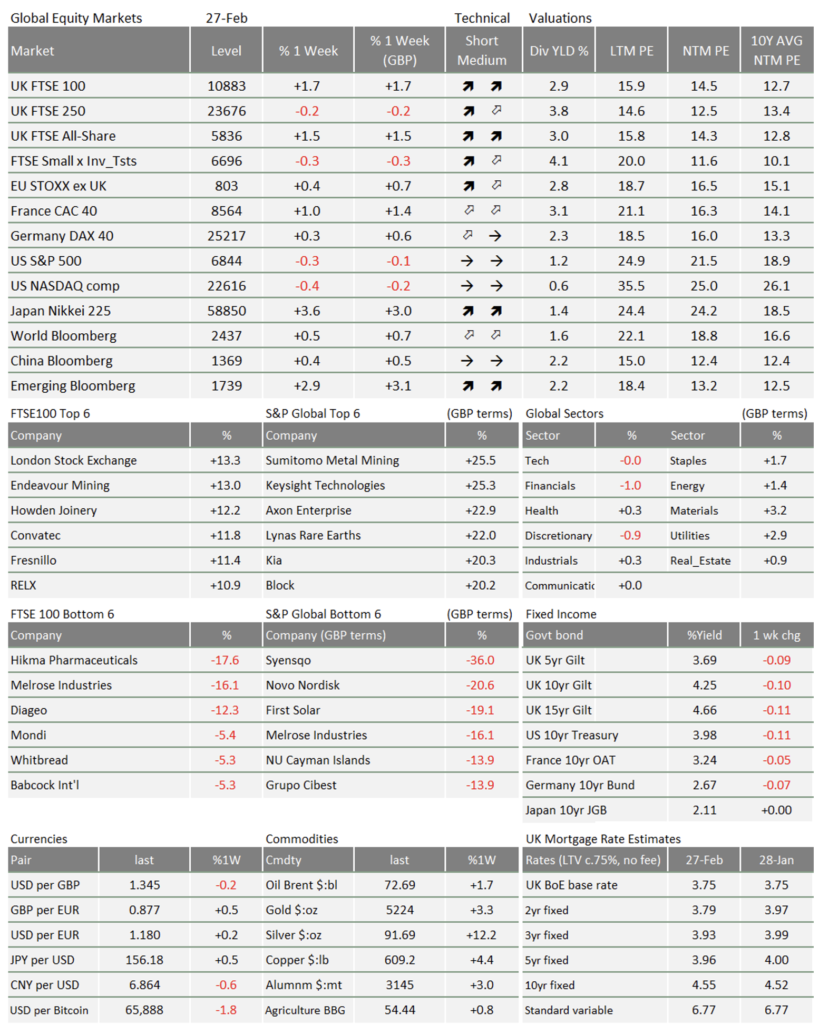
In response to the US-Israeli military strikes and Iran’s responses, markets have reacted in the way most would have expected.
- Spot Brent crude is trading at $80 per barrel, up from around $70-72 in Friday’s day trading and well above January’s $65 average: Natural gas prices are about 4% higher.
- Gold is above $5,400: Other metals are a little higher.
- The US Dollar is about 0.5% higher against major currencies and 1% higher versus emerging market currencies.
- US and European equity futures are about 1% lower while Japan and China are down more than 2%. The Turkish market is down over 5%.
- US 10-year treasury yields have actually risen slightly but remain below 4% after last week’s global government bond rally. Japan bond markets have seen slight yield falls, Europe and UK yields are also likely to open lower.
Spot oil prices will matter but investors will especially watch the futures contracts beyond six months for signals on whether there could be a wider impact on global growth and inflation.
Engineering a path to a new and stable Iranian political leadership will be neither easy nor quick. Investors will spend this week forming a view on how and when it ends. An important question regards China’s attitude and involvement. Can the US convince China that this conflict is not part of a strategy to further constrain its ambitions?
As we discuss below, risk markets are better positioned for a higher risk environment than a month ago, with cheaper valuations and less optimism. As such, at least we start the week with the sense that while there is obvious downside, many will look for an opportunity to buy if it becomes extended.
AI boom or doom
February was filled with polarising narratives but little price movements. The AI bubble talk has disappeared and, if anything, investor positioning might be negatively biased.
Blue Owl halting fund redemptions sparked fears of a private credit liquidity crisis – amplified by UBS research suggesting defaults could jump up if software companies are displaced by AI. Private credit firms invested big in tech companies. This is a risk scenario rather than a base case, but its probability has increased. Blue Owl halted redemptions out of investor fears, not actual defaults (which have fallen). People are understandably worried about a 2008-style contagion, but junk bonds in public markets haven’t been affected. There’s less leverage in the system than in 2008 (private credit firms can’t create money like banks) and for the firms that survive this could increase transparency for underlying assets.
Citrini research put out a hypothetical piece about a 2028 economy ravaged by AI, with service companies investing in their own obsolescence and collapsing the knowledge economy. The piece rocked markets despite containing no new data – showcasing the power of narratives. The competing narrative says adoption will be slower, allowing productivity growth to feed back into job creation. AI isn’t eating jobs yet (software engineer postings are up) but even if it does, it won’t show up in the data for a while. If the futurists are right about AI development, the backward looking data is immediately obsolete.
Global growth is still robust (2.1% in the US, 2% in the UK) and equity valuations are less stretched. The fact Nvidia shares fell, despite stellar earnings, means it is trading at a lower premium. Overly negative investor positioning should mean even mild relief squeezes up prices. Japan looks particularly strong – the only question being whether growth will be inflationary. Investors shouldn’t lose sight of the fact that the global economy keeps churning.
Where Europe now gets its gas
Ofgem’s 7% reduction in the energy price cap was made possible by falling UK and European natural gas prices, to £25/MWh in December, from nearly £50/MWh a year ago. Prices have bumped up more recently, due to colder US weather and concerns about EU gas storage dropping lower than usual for this time of year. A European cold snap drew on supplies at the start of 2026, but milder temperatures since have tapered demand. UBS analysts now expect storage to trough not much lower than current levels ahead of the summer restocking. Summer futures prices are still below current prices: traders are worried about current gas supplies (partly due to Iranian tensions) but calmer about future supplies.
Europe’s energy market has fundamentally changed in the last four years. Its biggest gas supplies are now Norway (31%) and the US (26.4%), though 12.1% still comes from Russia (mainly into Hungary and Slovakia). Most gas imports are LNG, over half of which comes from the US. Gas suppliers have invested heavily in port infrastructure to ship LNG across the Atlantic, which is tying our prices tighter to US gas prices. This is also why the EU is more comfortable running lower ‘just in time’ gas storage levels.
UK and European gas supplies are finally stable, and the EU has expanded its renewables capacity too (renewables overtook fossil fuels for the first time in 2025). There are still security concerns around gas: Norwegian pipelines could become targets in a hypothetical arctic theatre, and reliance on the US isn’t ideal in the age of Trump. Surging energy demand from AI datacentres poses a risk for energy prices (for the world) but the risks don’t detract from a supportive energy outlook.
Is the ‘Donroe Doctrine’ good for LatAm?
You’d think Donald Trump’s “Donroe Doctrine” (interventionist US dominance in the Western hemisphere) would be bad for Latin American companies, but Bloomberg’s LatAm index has surged 77% in sterling terms since January 2025. Morgan Stanley think the LatAm bull market will continue, mirroring the 2003-2007 surge, powered by AI infrastructure spending. This should benefit the ‘old economy’ of raw materials and manufacturing. Chile, a copper and lithium exporter, could particularly benefit. Morgan Stanley also think geopolitical shifts and falling interest rates will benefit LatAm stocks with historically low valuations, as the US shifts its demand to regional partners.
In a multipolar world, LatAm governments could actually move closer to the US, creating investment opportunities – like Mexico renegotiating the USMCA or Brazil enacting fiscal reforms. Commentators talk about US ‘friendshoring’, but that relies on being friends with Washington. Argentina’s $20bn currency swap line loan shows how lucrative friendship can be for Trump’s allies, but US patronage isn’t as personal as it sometimes seems. Washington will likely give tariff relief to Mexico if Mexico agrees to stem trade with China, and it already exempted Brazil from some tariffs when left-wing president Lula refused to budge. In a multipolar world, the US has a strong interest to attract LatAm to its pole.
We shouldn’t discount Trump’s tirades against drug cartels either. These have blighted LatAm governance, especially since the pandemic, and even those against US interventionism want the cartels gone. Stable institutions will benefit LatAm markets. Inflation has fallen across the region, partly thanks to post-pandemic monetary reforms. Lower interest rates could help LatAm markets expand. We wrote about the increasing importance of purchasing power parity (PPP) in the Trump era, and a PPP adjustment would also likely benefit. Yet again, Trump’s policies don’t always have the assumed impact.
This week’s writers from Tatton Investment Management:
Lothar Mentel
Chief Investment Officer
Jim Kean
Chief Economist
Astrid Schilo
Chief Investment Strategist
Isaac Kean
Investment Writer
Important Information:
This material has been written by Tatton and is for information purposes only and must not be considered as financial advice. We always recommend that you seek financial advice before making any financial decisions. The value of your investments can go down as well as up and you may get back less than you originally invested.
Reproduced from the Tatton Weekly with the kind permission of our investment partners Tatton Investment Management
Who are Vizion Wealth?
 Our approach to financial planning is simple, our clients are our number one priority and we ensure all our advice, strategies and services are tailored to the specific individual to best meet their longer term financial goals and aspirations. We understand that everyone is unique. We understand that wealth means different things to different people and each client will require a different strategy to build wealth, use and enjoy it during their lifetimes and to protect it for family and loved ones in the future.
All of us at Vizion Wealth are committed to our client’s financial success and would like to have an opportunity to review your individual wealth goals. To find out more, get in touch with us – we very much look forward to hearing from you.
The information contained in this article is intended solely for information purposes only and does not constitute advice. While every attempt has been made to ensure that the information contained on this article has been obtained from reliable sources, Vizion Wealth is not responsible for any errors or omissions. In no event will Vizion Wealth be liable to the reader or anyone else for any decision made or action taken in reliance on the information provided in this article.
