


Market Update: History does not repeat, but it often rhymes
Stock markets rallied in the early part of this week, but sold off on Thursday and into Friday. At the time of writing, we are at or even below last Friday’s levels in most major markets. The lacklustre performance might seem a little strange considering the biggest news story of the week was an end to the longest ever US government shutdown, after President Trump signed a federal funding bill until the end of January.
The shutdown disrupted the world’s largest economy and the global financial system, so we welcome its (temporary) end. It does not mean plain sailing, though.
Markets see weaker UK growth as a blip
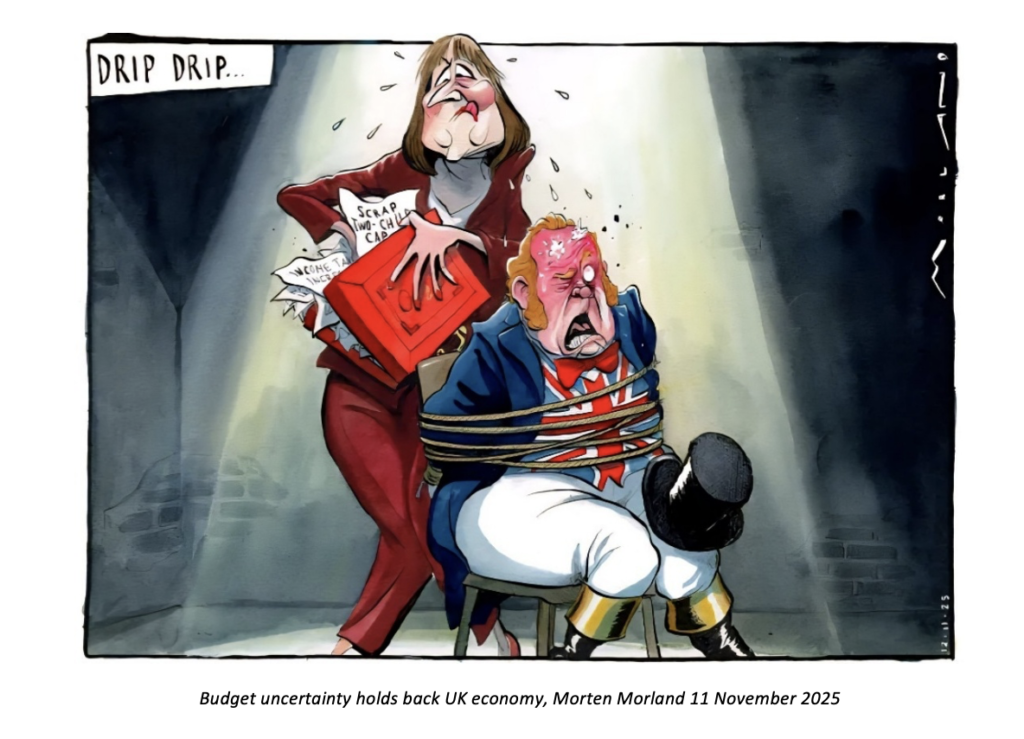
In matters closer to home, the FT reports that the Chancellor of the Exchequer has ditched the simple income tax-raising plans. This is bad news for UK markets and domestic growth, as simplicity is always better than a complicated system with unintended impacts. It makes it more difficult to assess the likely rises in revenues, so bond yields will be higher than they might have been, as investors have to build in risk buffers.
GDP data showed a basically flat UK economy in Q3 – and a contraction in the last couple of months. This largely comes from disappointments in industrial production, specifically related to the forced closure of Jaguar Land Rover factories, after the carmaker suffered a cyberattack in August.
There are other weak spots too: UK consumer sentiment does not look great (likely related to expected tax rises) and the latest house price data was weak. But in other respects, Britain’s economy is holding up okay. For example, services reported stronger than expected results. We are in a pattern of low, but steady, growth and that looks likely to continue.
Markets seem to be looking through the current malaise to better times ahead, although this week’s budget shifts may have worsened the situation. Government bonds barely reacted to the disappointing growth data, while the FTSE 100 is still among the world’s best performing stock markets year-to-date. Global investors have been a strong support and seem to think recent weakness is a blip. We still suspect they are right.
Opening government relieves liquidity pressure, but growth concerns remain
Despite cancelled flights and millions of Americans being furloughed, US stocks held up pretty well through the shutdown. Investors were feeling bullish until Wednesday, then Trump reopened the government and stocks sold off sharply the following day. This is a classic case of ‘buy the rumour; sell the fact’. It was notable that, from Thursday, the less loved parts of the US market (small cap stocks, industrials, healthcare – the areas most affected by the shutdown) had a relatively better time than the tech giants.
While US stocks show decent returns over the last month, it has since been a rough ride. The lack of federal payments meant a swelling of the US government’s Treasury General Account (TGA), meaning less liquidity in the financial system, and hence more volatile markets. Now that the US government is able to spend from the TGA again, that specific liquidity pressure will start to be relieved, ultimately supporting markets. However, it will take at least a couple of weeks for liquidity to flow through the system – into deposits, which back lending, which back asset purchases and so on. Investors that need liquidity right now might still struggle.
Still, there has been no sustained economic downturn and, despite valuations on larger cap tech stocks appearing expensive, investors have been relative cautiously positioned on stocks. The chart below shows the American Association of Individual Investors’ index of bullish investors minus bearish investors. Investors have leaned bearish for most of the year, but have now moved neutral (0 on the chart). Even if a dip is coming, there is enough capacity to bounce back.
At a fundamental level, the shutdown has created a drop in economic activity, but long lasting impacts should be small in the grand scheme (estimates of irretrievable loss are about $11bn). Unfortunately, the lack of official data published over the last 43 days means that investors are flying a little blind when it comes to US growth. Much of October’s data will be skipped entirely, rather than delayed. We have had to rely on private data sources in the meantime. Those have not been bad (like the recently positive credit card data) but we will have to keep an eye on US consumer trends, during a crucial spending season.

Capex is good, but it takes money out of markets
Liquidity flowing out of the US TGA again should mean less volatile markets. But as we have frequently pointed out, volatile does not always mean stocks going down. By the same token, lower volatility does not necessarily mean stocks going up. It should help build risk appetite, as smaller intraday price movements make equities feel less risky, but markets might just bide their time until we have a clearer outlook for the global economy.
Moreover, the TGA balance is far from the only liquidity factor. We have pointed out recently that the huge business investment plans into AI should support growth over the long-term, but does not necessarily support asset prices in the short-term (since money invested to build datacentres is money not returned to shareholders). The massive spike in Oracle’s credit costs this week is testament to that. Nobody thinks the cloud computing firm is going to default, but its increased demand for capital naturally forces investors to reassess.
This is just what happens when businesses invest to build, rather than distribute profits. It is ultimately a good thing, but it can feel scary for investors – particularly when there is so much talk of an AI bubble. The investment commentariat is currently abuzz with comparisons between AI and the late 1990s dotcom bubble, so we dedicate two separate articles this week to that analogy. In the meantime, markets will content themselves with a reprieve. If we end 2025 merely at the levels reached at the end of October, this would mean a third strong year for portfolio investors.

This week’s writers from Tatton Investment Management:
Lothar Mentel
Chief Investment Officer
Jim Kean
Chief Economist
Astrid Schilo
Chief Investment Strategist
Isaac Kean
Investment Writer
Important Information:
This material has been written by Tatton and is for information purposes only and must not be considered as financial advice. We always recommend that you seek financial advice before making any financial decisions. The value of your investments can go down as well as up and you may get back less than you originally invested.
Reproduced from the Tatton Weekly with the kind permission of our investment partners Tatton Investment Management
Who are Vizion Wealth?
 Our approach to financial planning is simple, our clients are our number one priority and we ensure all our advice, strategies and services are tailored to the specific individual to best meet their longer term financial goals and aspirations. We understand that everyone is unique. We understand that wealth means different things to different people and each client will require a different strategy to build wealth, use and enjoy it during their lifetimes and to protect it for family and loved ones in the future.
All of us at Vizion Wealth are committed to our client’s financial success and would like to have an opportunity to review your individual wealth goals. To find out more, get in touch with us – we very much look forward to hearing from you.
The information contained in this article is intended solely for information purposes only and does not constitute advice. While every attempt has been made to ensure that the information contained on this article has been obtained from reliable sources, Vizion Wealth is not responsible for any errors or omissions. In no event will Vizion Wealth be liable to the reader or anyone else for any decision made or action taken in reliance on the information provided in this article.
