


Market Update: Back to narrowing market breadth

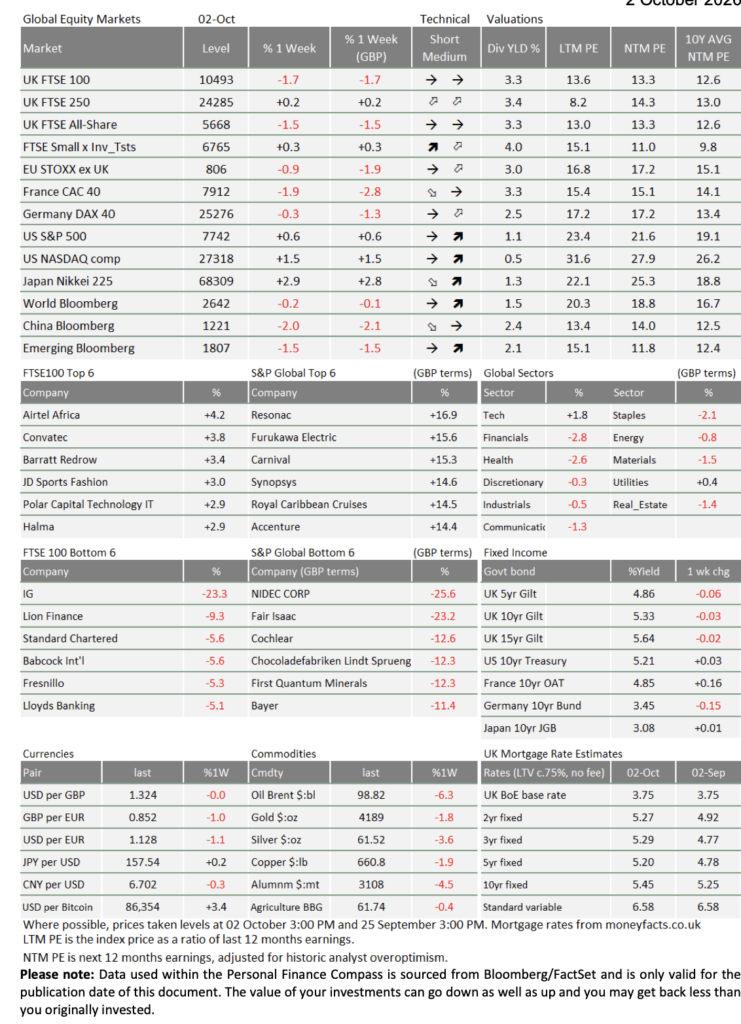
Global equities struggled somewhat last week. US tech stocks are roughly where they were last Friday – but many others took a hit. Markets see AI-fuelled growth as too strong, raising interest rate pressures for the rest of the economy. But last week, those pressures came back to bite the AI leaders themselves. Today’s lower-than-expected US employment figure eased concerns about an overheating economy, at least. As such, strong earnings growth should still be enough to buoy markets over the coming weeks.
UK finance commentators were disappointed by the lack of growth initiatives laid out in the Chancellor and Prime Minister’s conference speeches last week. But while they are sceptical about longer term fiscal discipline, markets are not overly worried about that discipline in the shorter term. That helped sterling keep pace with a stronger US dollar – even as the euro came under pressure.
Valuations hampered by a bit of credit stress
Datacentre firm Oracle saw its borrowing costs spike, after sending a ‘force majeure’ notice for its Project Jupiter lease obligations. Investors took this as a sign of credit stress, perhaps a little unfairly; Oracle was basically just saying it should not have to pay rent for an unfinished site. Its beleaguered bonds sold off regardless, with knock-on effects for broader tech credit spreads (the premium of corporate bond yields over government-issued bonds).
Rising debt costs usually hit companies with weaker credit ratings first but, last week, the AI winners bore the brunt. That could just be a side effect of all their recent debt issuance. Rather than a sign of AI firms’ credit stress, markets might just be struggling to digest this many new bonds at once. Still, rising debt costs make AI companies less likely to borrow more.
The problem for tech stocks is not so much what high credit spreads say about their debt, but what they imply for share prices. On the face of it, price-to-earnings valuations have cheapened this year, as earnings growth has outpaced share price gains. But to better understand relative valuations, you should factor in both real (inflation-adjusted) government bond yields and corporate credit spreads, as they are competing investments.
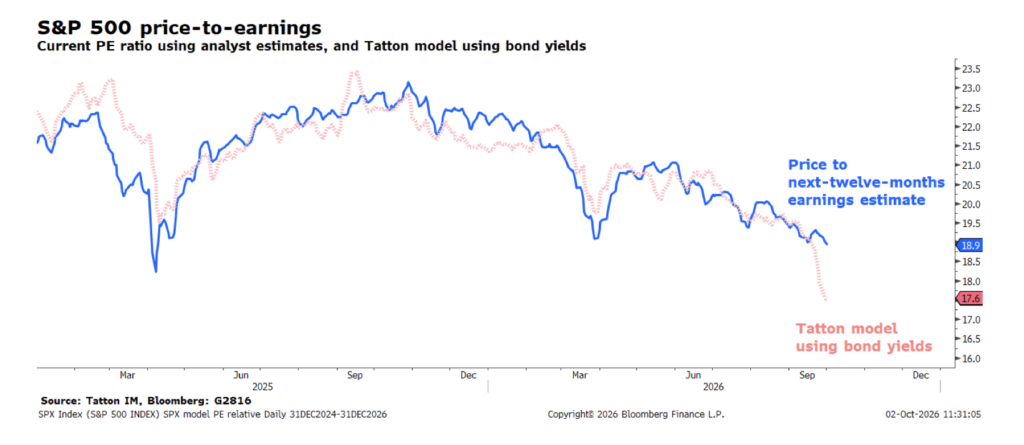
Adjusting for the recently higher real yields and credit spreads, it can be argued that from that angle, stocks should be cheaper or earnings stronger. We expect that the third quarter earnings reporting season, starting next week, will deliver strong profits – which generally ensures robust stock markets. But the attractiveness of real yields and credit spreads increases the pressure on companies to deliver those profits.
Good news is bad news; bad news may not be good news
Last week, bond yields were pushed up by strong economic data (government yields should theoretically reflect growth and inflation). So, you would think that this week’s lower-than-expected US core inflation data would pull yields back down. Not so: real yields initially rose sharply again, before falling back.
Rising long-term real yields normally signify stronger growth expectations. Current US growth has moved back up to an annualised rate of 2.4%, after a summer soft patch. If consumer confidence rises in line with business confidence, the US economy would have too much demand for its supply and the Federal Reserve would have to slow things down. However, inflation itself is less concerning, and today’s weaker-than-expected jobs report suggests consumers will remain reticent.
Meanwhile, the rest of the world is lagging. High energy prices are curtailing Europe’s growth, more than raising its inflation. Real money supply has started contracting, which may even force the European Central Bank to turn dovish (preferring lower interest rates).
The mixed global growth outlook suggests bond yields are high for other reasons. Renowned market strategist Ed Yardeni wrote this week that the Bank of Japan’s recent interest rate rises have had a profound effect on global bond markets. The so-called ‘yen carry trade’ – borrowing cheaply in yen to fund higher yielding US bonds – provided a backstop of global bond demand for years, but the BoJ’s rate hikes have now made the trade less profitable.
Yardeni has a point, but the yen carry unwind is likely one of many factors, along with intense AI capital demand, increased fiscal risks and years of bond price volatility.
In any case, markets are in the strange situation where strong growth is seen as bad for bonds and, consequently, stocks – but weak growth is not good either. Right now, markets would probably only consider mediocre growth to be good news. That is why today’s soft US employment gain lowered yields and buoyed stocks.
Geopolitics hurt but earnings could come to the rescue
What would be unequivocally good news for markets is lower oil prices. Rumours of possible US-Iran talks pulled oil below $100 per barrel this week – reinforced by Middle Eastern oil exports reaching their highest point since the war began.
Unfortunately, oil rose back up after President Trump’s dismissive response to Tehran’s olive branch. It seems that ‘Art of the Deal’ tactics are preventing both sides from meaningful negotiation: any sign that Tehran is willing to compromise is seen by Washington as a weakness to be exploited rather than a window of negotiation, and vice versa. If a resolution on oil flow does come, it will most likely be quick and unexpected.
Other geopolitical tensions could also arise at the meeting of G20 trade ministers this weekend in Milwaukee – a prelude to the G20 leaders’ summit in December. Russia’s trade minister is there and Vladimir Putin will attend later this year, on Trump’s invite. Given Putin’s recent threats against Europe, this weekend’s summit could be about more than trade. European leaders are considering releasing diesel reserves. These reserves are for international emergencies – not to buffer price movements. Given Putin’s actions have raised the likelihood of war, leaders will want to persuade Trump not to bar US diesel exports in the coming days.
Corporate profits should at least bring good news. Judging by strong economic data over the last three months, the Q3 earnings season should be a good one for investors. Early results from chipmaker Micron back up that bullishness. As usual, strong company profits keep drowning out the worries elsewhere, particularly around valuations.
This week’s writers from Tatton Investment Management:
Lothar Mentel
Chief Investment Officer
Jim Kean
Chief Economist
Astrid Schilo
Chief Investment Strategist
Isaac Kean
Investment Writer
Important Information:
This material has been written by Tatton and is for information purposes only and must not be considered as financial advice. We always recommend that you seek financial advice before making any financial decisions. The value of your investments can go down as well as up and you may get back less than you originally invested.
Reproduced from the Tatton Weekly with the kind permission of our investment partners Tatton Investment Management
Who are Vizion Wealth?
 Our approach to financial planning is simple, our clients are our number one priority and we ensure all our advice, strategies and services are tailored to the specific individual to best meet their longer term financial goals and aspirations. We understand that everyone is unique. We understand that wealth means different things to different people and each client will require a different strategy to build wealth, use and enjoy it during their lifetimes and to protect it for family and loved ones in the future.
All of us at Vizion Wealth are committed to our client’s financial success and would like to have an opportunity to review your individual wealth goals. To find out more, get in touch with us – we very much look forward to hearing from you.
The information contained in this article is intended solely for information purposes only and does not constitute advice. While every attempt has been made to ensure that the information contained on this article has been obtained from reliable sources, Vizion Wealth is not responsible for any errors or omissions. In no event will Vizion Wealth be liable to the reader or anyone else for any decision made or action taken in reliance on the information provided in this article.
