


Market Update: Waiting for Goldilocks
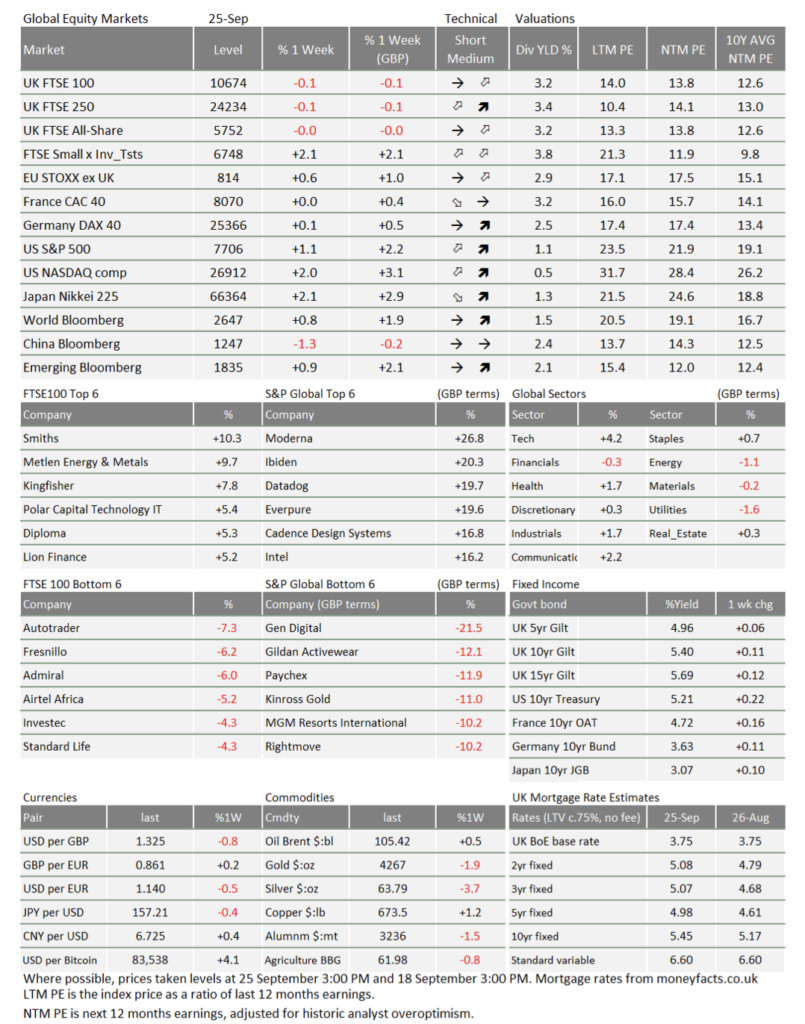
Government bond yields keep rising. The US 10-year yield shot up to 5.2%, its highest level in nearly 20 years. This pushed up yields for all other bonds. That was not a problem for stock markets – until it was. Equities continued the theme of shrugging off bond drama in the early part of last week, but most indices dropped in the last few days. The one exception, perhaps unsurprisingly, was the mega-cap US tech stocks. How much longer can the AI trade go it alone?
Bond investors nostalgic for the 2010s
We should point out that US 10-year yields did break the 5% barrier briefly in late 2023, so last week’s rise is not quite the epochal moment some media commentary suggests. But a sustained rise above 5% is undoubtedly significant.
People tend to blame the oil price shock for yield rises – and last week’s bump up in Brent crude oil certainly did not help. But the key bond driver recently has been economic growth expectations, rather than inflation. The “flash” Purchasing Managers’ Indices (business sentiment surveys) surprised positively in most major economies (except China). In the US, they were remarkably strong. That suggests more growth ahead, which typically pushes up bond yields, as bonds compete with growing stocks.
Stronger growth might sound like a good thing, but it is a problem for the Federal Reserve. With constrained supply, the US is probably already operating at capacity in many areas – which means that any further demand increase will feed directly into persistently higher prices. That is why the Fed has become more hawkish (preferring higher interest rates) to stem inflation pressures. In response, market prices now imply another rate hike next month, following thehike a couple of weeks ago.
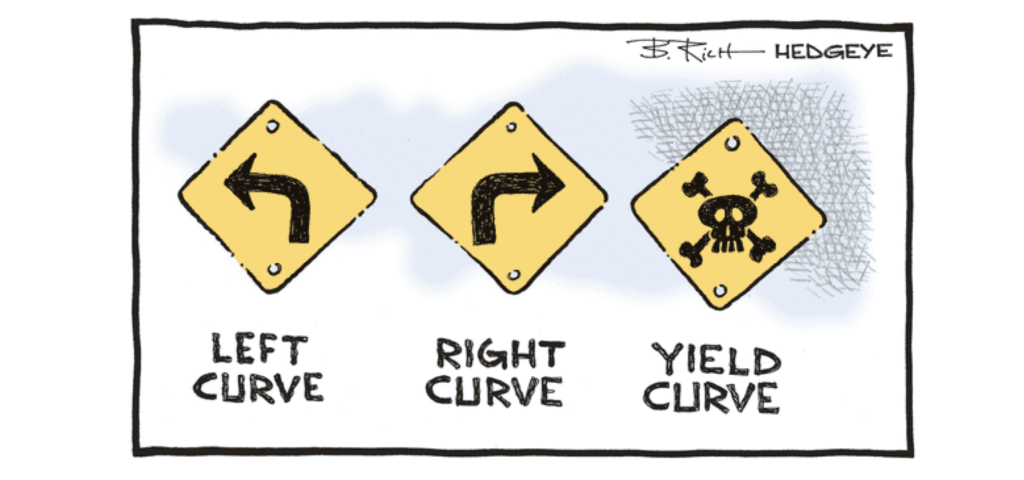
Interestingly, short-term rate expectations rose faster than long-term bond yields, meaning a flatter yield curve – the difference between bond yields of long- and short-term maturity. That effectively means tightening financial conditions, as liquidity gets more expensive to fund. That is why stock markets took a hit. Investors want the slow-but-steady growth that characterised the 2010s – the so-called ‘goldilocks environment’ – rather than current, potentially inflationary growth.
Many parts of the global economy are already straining from high interest rates: smaller companies, non-tech companies and government finances. But the AI investment spree powering growth and stock markets keeps motoring, seemingly unaffected by rates. SoftBank’s new $11bn bond raise at yields of close to 10% demonstrates this.
Trump greets Xi with a smile
President Xi touched down near Washington for his meeting with Trump on Wednesday night – and the US President could hardly wait for him to get off the plane. Ahead of the summit, US Treasury Secretary Scott Bessent had already announced an extension of the US-China trade truce agreed earlier this year. Tariffs will be suspended until January, conveniently after the US midterm elections.
There has been very little of note from the actual Trump-Xi meeting. The leaders of the world’s two largest economies appear to be playing nice, at least, not wanting to generate any negative headlines. That is to be expected from Xi, but a remarkable show of restraint from Trump.
There may be some minor policy announcements on Friday, after we finish writing. Both governments have incentives to find trade agreements that they can present as victories – and there are deals to be done in certain areas. More important is the overall sense of détente. There is unlikely to be any extra tariff disruption between Washington and Beijing for now, as we head into the busy Christmas period for US consumers.
Trade détente cannot hurt Trump’s Republican party in the midterms, but it is unlikely to help much either. High gas and diesel prices are the main electoral liabilities. On that front, some had hoped that Trump might persuade Xi to pressure Iran, China’s oil provider, to compromise harder – but that looks unlikely.
How sustainable is the AI-or-nothing economy?
Bonds and smaller stocks sold off, in what looks like the classic ‘crowding out’ – one area demands so much capital that there is not enough left for other areas. That demand is coming from tech stocks, which are about the only thing keeping markets going. They were buoyed last week by the release of Meta’s Muse personal AI agent. Market breadth – the measure of how many stocks are rising – has narrowed substantially again and the AI theme is dominating once more. Indeed, the fact AI companies now have vast cash piles waiting to be invested into infrastructure is one of the reasons that overall market liquidity is holding up okay, despite central banks turning hawkish.
Something curious is happening with those cash piles. We know AI companies are borrowing billions to build datacentres but, strangely, there are some signs that these datacentres are not being built very quickly. Relatedly, the much-discussed increase in AI computing capacity has not materialised.
Oddly, this slower growth in computing capacity has not resulted in higher compute prices. The latest data suggest that demand for AI tokens is not rising faster than the relatively slow increase in supply. If that is right, then a faster pace of datacentre building from AI firms could result in a computing overcapacity.
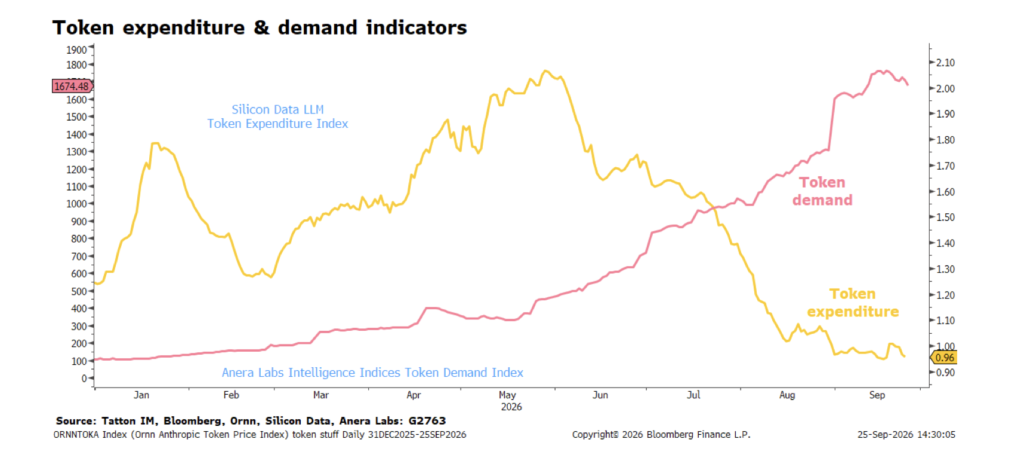
If companies have unspent investment capital, there is already enough capacity around and the cost of debt financing is going up, you would expect them to stop raising yet more capital. In other words, the big AI debt spree we thought was impervious to interest rates might become more rate-sensitive after all.
That is one potential route back to the goldilocks environment: the AI spend slows in line with the rest of the economy, allowing hawkish central bankers to back off. The other potential route is a sudden unexpected drop in oil and gas prices – but we will not hold our breath on that one. Without those changes, stock markets will probably get narrower still. That does not preclude investment returns, but it makes them more fragile.
This week’s writers from Tatton Investment Management:
Lothar Mentel
Chief Investment Officer
Jim Kean
Chief Economist
Astrid Schilo
Chief Investment Strategist
Isaac Kean
Investment Writer
Important Information:
This material has been written by Tatton and is for information purposes only and must not be considered as financial advice. We always recommend that you seek financial advice before making any financial decisions. The value of your investments can go down as well as up and you may get back less than you originally invested.
Reproduced from the Tatton Weekly with the kind permission of our investment partners Tatton Investment Management
Who are Vizion Wealth?
 Our approach to financial planning is simple, our clients are our number one priority and we ensure all our advice, strategies and services are tailored to the specific individual to best meet their longer term financial goals and aspirations. We understand that everyone is unique. We understand that wealth means different things to different people and each client will require a different strategy to build wealth, use and enjoy it during their lifetimes and to protect it for family and loved ones in the future.
All of us at Vizion Wealth are committed to our client’s financial success and would like to have an opportunity to review your individual wealth goals. To find out more, get in touch with us – we very much look forward to hearing from you.
The information contained in this article is intended solely for information purposes only and does not constitute advice. While every attempt has been made to ensure that the information contained on this article has been obtained from reliable sources, Vizion Wealth is not responsible for any errors or omissions. In no event will Vizion Wealth be liable to the reader or anyone else for any decision made or action taken in reliance on the information provided in this article.
