


Market Update: Bond yields’ multi-facetted messaging
Hawks to the rescue
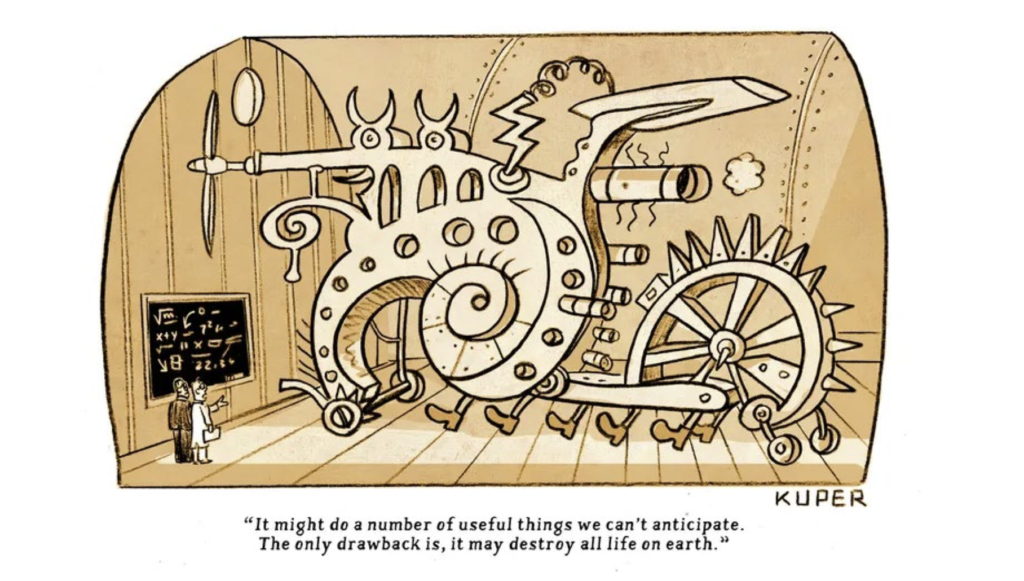
Interest rate hikes in the US and Japan, and a clear signal of one on the way in Britain, boosted central banks’ reputations for combating inflation; they said more were likely, with energy prices remaining the biggest factor.
French debt looms large
It may be too big to fail, but it is certainly too big to bail – government debt in France is a big problem, and not just for the French.
Stocks and bonds split up
Stocks have outperformed bonds for the past 17 years but, with newly attractive bond yields and stock market risks on the rise, will this outperformance continue?
Hawks to the rescue
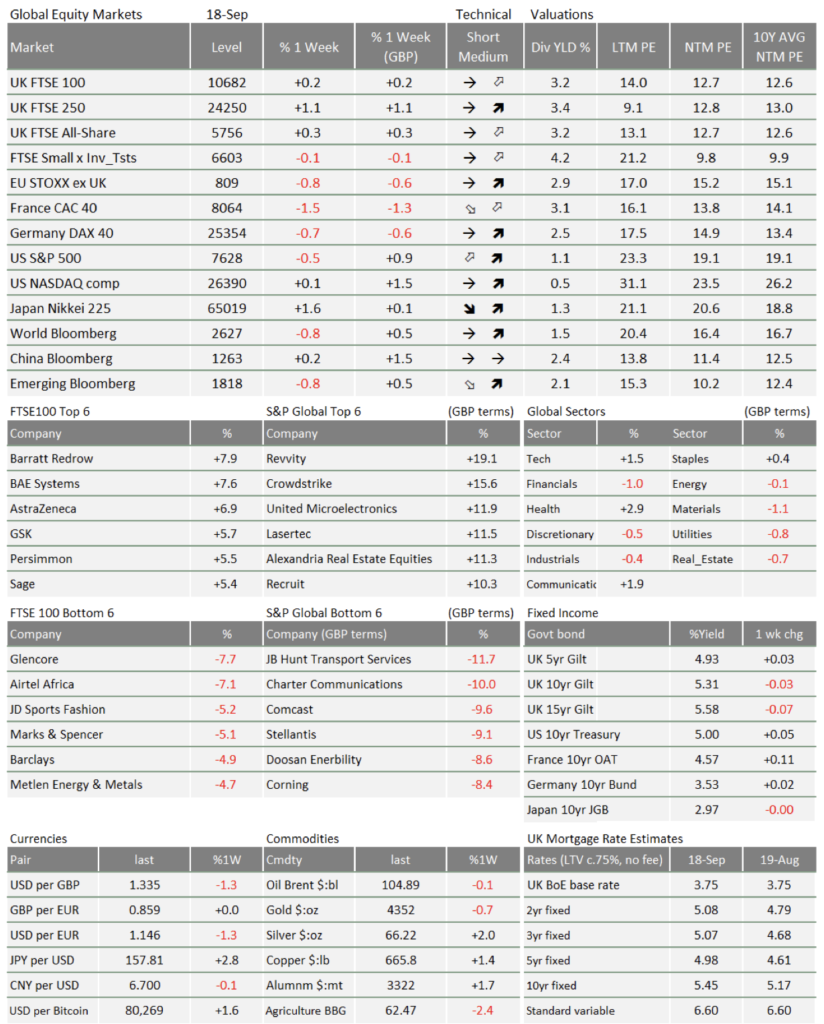
Last week was heavy on narrative but, for the most part, light on stock market movement. President Trump bristled at Canada’s flirtation with Europe, tech leaders made a plea for slower AI development and attacks on Middle Eastern oil infrastructure continued. These stories had only minor impacts, not moving markets too much in either direction.
Markets were moved – sharply down then back up – by central banks. The Federal Reserve raised US interest rates by 0.25 percentage points on Wednesday, as Chairman Kevin Warsh emphasised his inflation-fighting credentials. The Bank of England declined to join the Fed just yet, but signalled a rate rise for November. The Bank of Japan then closed out the week with a widely anticipated 0.25 percentage point hike on Friday. In the end, central bankers’ tough talk helped calm some nerves.
Warsh affirms Fed independence
In the minutes after Warsh’s speech, government bond yields rose and stocks fell. The Fed chair delivered on his recent hawkish rhetoric by raising rates and signalling potentially more to come. Warsh famously hates giving markets ‘forward guidance’ of Fed policy, but his promise to quash inflation was about as clear guidance as he could give. Tellingly, he phrased the hike as removing the Fed’s “dose of accommodation”, rather than actively restricting the economy.
Markets then calmed from their initial reaction. Yields on 10-year US treasury bonds dropped below 5% again, stock prices recovered and the dollar strengthened. Market-based inflation expectations dropped substantially – helped by falling oil prices, admittedly. We interpret these moves as a bolstering of the Fed’s credibility: the central bank will squeeze right now, but lower future inflation will allow markets to breathe.
In particular, Warsh’s speech was a win for Fed independence. The Fed chair is anything but the Trump stooge that some critics alleged when he was picked by the president. Strangely, Trump gave his full confidence to Warsh on Wednesday, despite lambasting the Fed’s decision. The president seemed to suggest that Warsh wants lower rates but is being thwarted by the rest of the Fed board – a sharp contrast to Warsh’s own comments.
Whether Trump believes that or is merely saving face, it is a good sign. Warsh is right that the strong US economy can cope with a hike right now and, if that changes, his willingness to react to incoming data suggests the Fed could quickly turn dovish if needed.
The BoE eases its gilt-y conscience
Bank of England (BoE) members voted 6-3 to keep rates unchanged, but strongly signalled they will hike in November. Markets took the result as a signal that the BoE is getting tougher on inflation, benefiting UK assets. UK government bond (gilt) yields dropped sharply on Thursday.
The BoE’s biggest gift to gilts was its plan to reduce its sale of long-term bonds and sell them directly back to the Treasury – the government effectively buying back its own long-term debt. Most central banks have reduced or stopped their quantitative tightening (QT) programmes of bond sales in recent years, but the BoE has carried on. That has been a significant factor in gilts’ underperformance.
The other big factor, as we often argue, is the imbalance of outstanding gilts. They are heavily inflation-linked and skewed to the long-term, making gilt yields more sensitive to global bond moves. The buyback plan effectively swaps high-interest long-term debt for lower-interest short-term debt – similar to US Treasury Secretary Scott Bessent’s plan announced a few weeks ago.
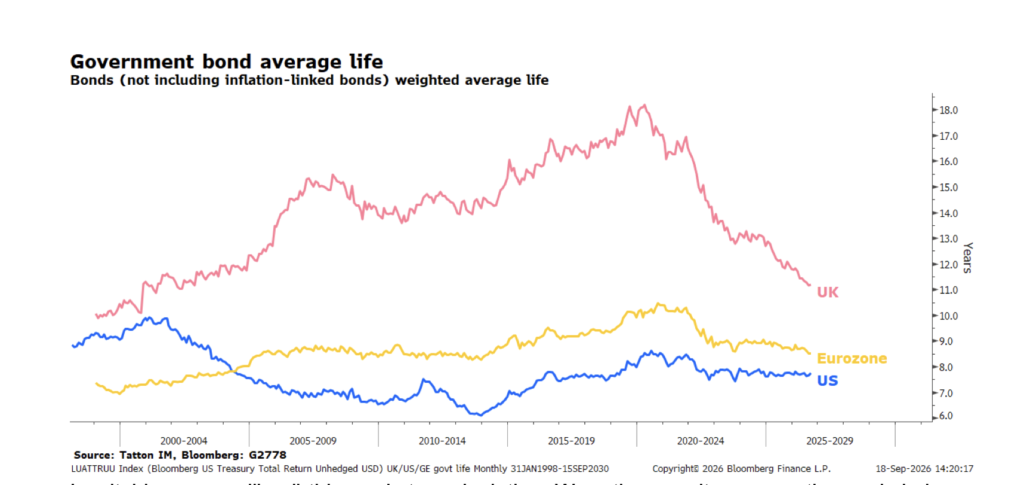
Inevitably, some will call this market manipulation. We rather see it as correcting an imbalance caused by previous policies. As the chart above shows, gilts’ average maturity has already declined in recent years, from a very high level. Gilts still have some way to go, and the BoE’s latest policy will help.
Inflation eases but market nerves remain
The Bank of Japan (BoJ) backed up central banks’ hawkish consensus by raising rates on Friday – though the BoJ’s two political appointees voted for no rate rise. The bolstering of monetary credibility had a calming effect on bond markets but, in the near term, a more hawkish BoJ could well lead to selling pressure for global bonds.
Renowned economist and market strategist Ed Yardeni recently argued as much, pointing to the potential unwind of the so-called ‘yen carry trade’. This popular trade involves investors borrowing cheaply in yen to buy US assets, particularly US treasury bonds. Low Japanese rates and a weakening yen make that trade profitable – so higher Japanese rates and a stronger yen encourage those investors to sell their treasuries. That might make bond markets choppy, but the BoJ’s move is still a positive for global inflation.
Midweek, it looked like inflation would also be eased by falling oil prices, as Saudi Arabia announced that much of its damaged East-West pipeline capacity could be quickly restored. But oil prices unfortunately climbed again during late Thursday trading and continued to bounce around on Friday. Oil price volatility will continue to challenge markets.
Finally, last week also saw some high-profile pronouncements on the need to slow global AI development – from the very people leading its rapid growth. It is not entirely clear how investors should interpret these grave warnings, like Anthropic CEO Dario Amodei’s claim that regulation is needed to blunt AI’s existential threat. We only note that the calls to slow down are coming just as the AI spending race dramatically raises costs for tech firms.
The stocks most at risk from a slowing in AI spending – chip manufacturing companies – reacted nervously to the news, but finished the week stronger. This was just the latest twist in the AI theme that has propelled stock markets for years, and it will not be the last. For the world economy, the silver lining is that if AI spending is slower, it might provide relief from medium-term inflation pressures. Central bankers would appreciate it.
This week’s writers from Tatton Investment Management:
Lothar Mentel
Chief Investment Officer
Jim Kean
Chief Economist
Astrid Schilo
Chief Investment Strategist
Isaac Kean
Investment Writer
Important Information:
This material has been written by Tatton and is for information purposes only and must not be considered as financial advice. We always recommend that you seek financial advice before making any financial decisions. The value of your investments can go down as well as up and you may get back less than you originally invested.
Reproduced from the Tatton Weekly with the kind permission of our investment partners Tatton Investment Management
Who are Vizion Wealth?
 Our approach to financial planning is simple, our clients are our number one priority and we ensure all our advice, strategies and services are tailored to the specific individual to best meet their longer term financial goals and aspirations. We understand that everyone is unique. We understand that wealth means different things to different people and each client will require a different strategy to build wealth, use and enjoy it during their lifetimes and to protect it for family and loved ones in the future.
All of us at Vizion Wealth are committed to our client’s financial success and would like to have an opportunity to review your individual wealth goals. To find out more, get in touch with us – we very much look forward to hearing from you.
The information contained in this article is intended solely for information purposes only and does not constitute advice. While every attempt has been made to ensure that the information contained on this article has been obtained from reliable sources, Vizion Wealth is not responsible for any errors or omissions. In no event will Vizion Wealth be liable to the reader or anyone else for any decision made or action taken in reliance on the information provided in this article.
